Data Quality Failures in Financial Reporting Restatements
Faulty data pipelines, not judgment lapses, drive recurring restatement errors.
Restatements are falling, but the drop is mostly an accounting artifact of the SPAC boom unwinding, not proof that financial reporting has gotten cleaner. Total SEC restatements fell 18% in 2025, from 477 to 391, the second-lowest annual count in Ideagen Audit Analytics' twenty-year dataset. Stripping out the SPAC noise leaves a smaller but stubborn set of failures that trace back to the same place every time: how data gets captured, classified, and moved through the systems that feed a financial statement. The judgment calls get the blame. The plumbing deserves it.
Which accounting areas keep producing restatements, and what they share
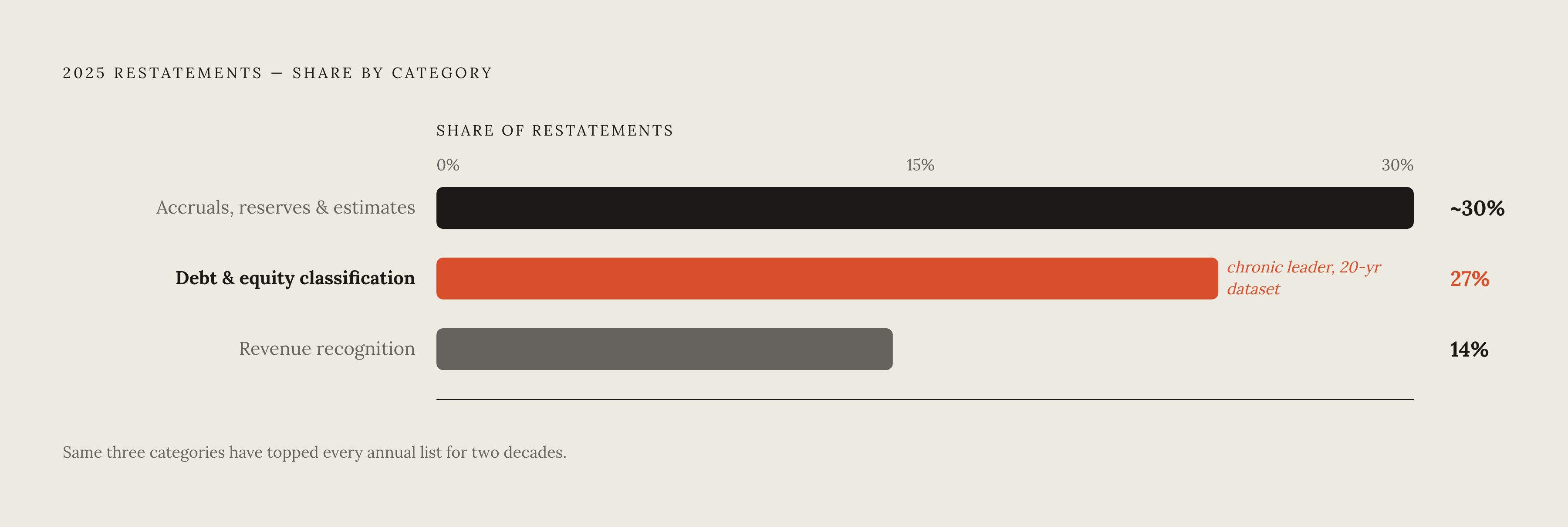
Debt and equity classification has topped the restatement list every single year of the twenty-year dataset, with Ideagen finding that in 2025 it accounted for 27% of all restatements. That's not a fluke or a one-off industry event. It's a chronic structural failure, the kind that survives multiple audit cycles, several rounds of new accounting guidance, and whatever enforcement pressure the SEC applies in a given year. Ideagen's findings show that revenue recognition, meanwhile, climbed back to 14% of 2025 restatements, and accruals, reserves, and estimates have historically made up 30% of the total.
Look at what these categories actually have in common: none of them are exotic. Debt and equity classification isn't a frontier accounting question. Revenue recognition rules have been stable for years. What connects them is that each one depends on data arriving correctly from operational systems before any judgment gets applied to it. When a sound accounting rule receives bad inputs, the output is wrong no matter how careful the person applying the rule happens to be.
Foreign private issuer restatements rose to 52 in 2025, the highest count since 2007. Cross-border tax treatment and consolidation add extra layers of transformation, and each layer is a place where a field gets mapped wrong, a currency gets misclassified, or a subsidiary's chart of accounts doesn't line up cleanly with the parent's. A UK regulatory body reaches a similar conclusion from a different dataset. Its Annual Review of Corporate Reporting for 2024/25 identifies recurring issues that overlap heavily with the US pattern, suggesting these failure types aren't tied to one jurisdiction's rulebook. That pattern tracks pretty closely with which companies can afford mature data infrastructure and which can't.
None of the dominant error categories call for rare accounting expertise. They call for accurate classification and consistent aggregation, upstream of the point where anyone applies judgment at all.
Four real restatements from 2025–2026 and the data failure inside each one
WK Kellogg Co disclosed, in a Form 8-K and DEFA14A tied to an event dated July 31, 2025, that it had understated inventory and overstated cost of goods sold by roughly $11 million for the fiscal year ended December 28, 2024, with the same error present across four quarterly periods. The SEC filing points to "discrete reporting processes established at the time of the spin-off from Kellanova," which produced inventory adjustments that inadvertently double-counted certain manufacturing expenses. Nobody caught this at the original filing. It appeared during preparation of the Q2 2025 statements, through trend analysis inside the ordinary financial reporting process, not through any audit control designed to catch it. The company's board eventually concluded that all five affected financial statements, the 2024 10-K plus four quarterly reports, could no longer be relied upon. The pipeline was wrong from the day the spin-off split it in two, and it stayed wrong for over a year before anyone noticed.
Allurion Technologies filed a Form 10-Q/A on August 19, 2025, correcting errors that originated in its 2023 and 2024 financial statements and ran through multiple quarters into March 2025, misstating other comprehensive income, net income, and accumulated deficit. The root cause named in the filing is a material weakness tied to a lack of staff with public company and technical accounting experience. That's a staffing gap, but it becomes visible as a data output problem: without people who know how to classify and validate what's flowing into the statements, errors compound quietly for two years running.
Specificity, Inc. filed a Form 10-K/A in 2026 for the fiscal year ended December 31, 2025, after management failed to obtain and review bank and credit card statements tied to accounts opened in mid-December 2025. That's not a judgment failure at all. It's a coverage gap: specific source documents never made it into the reporting pipeline in the first place.
Flux Power Holdings, in a 2025 Form 10-K, restated financial statements for fiscal years 2023 and 2022 and related quarterly periods spanning multiple fiscal years, citing improper accounting for inventory as a central root cause. Inventory is a factor here again, echoing WK Kellogg almost exactly, which reinforces inventory classification as one of the more persistent failure zones in the entire dataset.
None of these four cases trace to deliberate manipulation or an unusually hard judgment call. Each one traces to a specific, identifiable breakdown in how data was captured, classified, or moved before anyone applied accounting rules to it. That pattern lines up with SEC enforcement data too: 83 accounting-related enforcement actions in 2023, up 22% from the year before, with 35 tied directly to restatements, often rooted in revenue recognition failures (per rightrev.com).
The specific pipeline mechanisms that turn data problems into restatements
Schema drift is probably the quietest of these failure modes, and also the hardest to catch, because nothing breaks when it happens. An upstream team adds a column, renames one, or drops one, and doesn't tell whoever downstream is relying on it. The pipeline keeps running. No error gets thrown. It just drops a field, misreads a data type, or aggregates over data that's now incomplete, and finance doesn't find out until a quarterly report fails to reconcile with the source system, sometimes a full period or two later. Research cited by hst.ie puts the cost of this at European SMBs losing an average of two to three business days per quarter just reconciling schema-related issues.
Related to that is what the industry calls silent data quality degradation: anomalies that never announce themselves as errors, but instead quietly distort the numbers, wearing down confidence in dashboards and reports over time (per datagaps.com's data observability guide). WK Kellogg's double-count is the clean real-world case. The pipeline ran without incident for more than a year. The error wasn't a glitch that popped up and vanished. It was structural, built into the process from the spin-off onward, and it stayed invisible the whole time.
Third-party and vendor data introduces its own version of the same problem. One illustrative case (hst.ie) describes a manufacturing company whose vendor master data pipeline broke because of duplicate vendor IDs in the source ERP system; the resulting accounts payable report overstated the actual figure by a substantial margin, and it took significant manual effort just to trace where the dependencies had gone wrong. Specificity, Inc.'s restatement is the real-world equivalent: bank and credit card statements for accounts opened in mid-December were never obtained and reviewed before the year-end close.
Corporate events add another layer entirely. Mergers, spin-offs, and acquisitions tend to fragment reporting processes right at the moment they most need to stay whole. WK Kellogg's error trace directly to "discrete reporting processes established at the time of the spin-off," meaning the architecture itself was wrong before a single transaction ran through it. The jump in foreign private issuer restatements, 52 in 2025, likely reflects a similar dynamic playing out across borders: consolidation and tax data moving between systems that don't share a schema or a classification standard.
Manual work compounds all of it. Abacum.ai reports that finance teams have historically spent somewhere around 75 to 80% of their time on data collection and manual reporting tasks, which leaves very little bandwidth left over to actually notice when something's off. Without automated lineage tracking, preparing for an audit can eat up two to three weeks of manual documentation work (per hst.ie). Manual steps aren't just slow. They're exactly the points where data gets re-entered, re-classified, or dropped altogether. Taken together, the same research cited by hst.ie finds that schema changes, silent quality degradation, unmonitored third-party API changes, resource contention during peak processing loads, and the absence of end-to-end data lineage account for 78% of production data pipeline failures affecting European SMB financial reporting.
None of this is an accounting judgment failure. It's a data engineering failure that accounting eventually catches, if it catches it at all.
What restatements cost, beyond the correction itself
Quantum Corp's own 10-K states: restatements are "time-consuming and expensive," exposing the company to "unanticipated costs for accounting and legal fees" and the risk of stockholder litigation. That's about as candid an admission of the cost structure as a filing gets, and it's worth taking at face value.
The legal exposure is climbing even as the raw restatement count falls. Those 83 SEC accounting enforcement actions in 2023, a 22% jump from 2022, included 35 tied directly to restatements. Fewer restatements overall, in other words, hasn't translated into less legal risk per restatement.
The broader cost of bad data, separate from restatements specifically, gives a sense of scale. Gartner estimates that poor data quality costs organizations an average of $12.9 million a year, and more than a quarter of organizations report losses exceeding $5 million, with 7% reporting losses of $25 million or more. Unity Software's 2022 disclosure attributed a $110 million revenue loss and $4.2 billion in market cap erosion to what it called the consequences of ingesting bad data from a large customer, showing what that scale of loss looks like in practice. That's not even a restatement case. It's a data quality event with restatement-sized consequences.
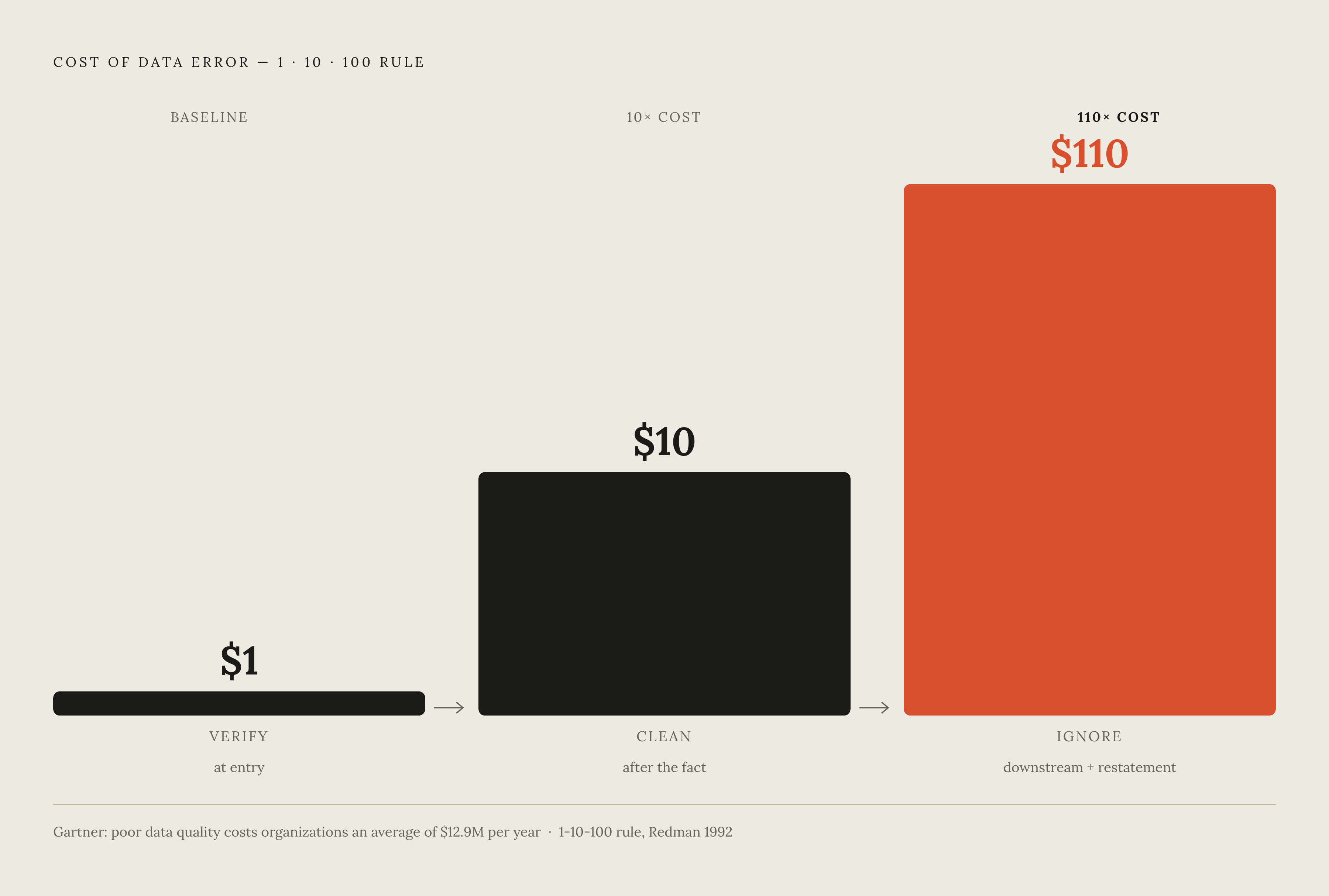
Equifax offers a similar lesson from a different angle: bad data produced inaccurate credit scores sent to lenders across millions of customers, and the fallout included regulatory scrutiny, class-action litigation, a settlement of $725,000 for credit reporting and dispute-handling failures, among other penalties. The 1-10-100 rule captures the underlying math cleanly: verifying a record costs a dollar, cleaning it after the fact costs ten, and leaving it uncorrected can run up to $110 in wasted operational cost downstream. A restatement sits at the far end of that curve.
Internal control over financial reporting doesn't catch any of this in time to matter financially. The CAQ study found that ICFR reports typically flag issues only after a restatement has already been announced. The standard control apparatus documents the damage rather than preventing it. By the time the flag goes up, the cost is already spent.
Why the standard control framework catches errors late, and what that gap looks like in practice
ICFR's core weakness is timing. The CAQ finding that ICFR reports "typically flagged issues after restatements were announced" says as much: these reports are a record of failure, not a check against it. Allurion's material weakness, the lack of staff with public company and technical accounting experience, only got identified once the resulting errors had already spread across multiple reporting periods. The control existed. It just arrived after the damage.
External audit isn't a clean backstop either. IFIAR's Annual Survey of Inspection Findings reports that 34% of inspected audits at the top six accounting firms had at least one deficiency. Even the check meant to catch what internal controls miss has a real failure rate of its own.
The lag is clear in the WK Kellogg timeline. The double-count ran undetected across the fiscal year ending December 28, 2024, and four quarterly periods encompassed within that span, and it only surfaced during Q2 2025 preparation, through management's own trend analysis rather than through any formal control designed for the job. Specificity, Inc.'s failure is even more direct: management simply never obtained the bank and credit card statements for newly opened accounts, a gap in coverage that the standard period-end close process didn't catch at all.
Manual reconciliation often gets treated as a stand-in for a real control, and it can't do the job. Without automated lineage, reconstructing an audit trail by hand can take two to three weeks (per hst.ie), and that kind of process doesn't scale and won't catch degradation that's happening quietly, upstream, while everyone's looking at the output. Data errors don't announce themselves. By the time a period-end reconciliation reveals a discrepancy, the error has often already touched multiple reporting periods.
The real gap here is between where these errors actually start, inside pipelines, source systems, schema changes, and corporate events like spin-offs, and where the control apparatus actually gets applied, which is a... It's between where these errors actually start, inside pipelines, source systems, schema changes, and corporate events like spin-offs, and where the control apparatus actually gets applied, which is almost always at the output end of the reporting cycle, long after the error has had time to compound.
What catching failures earlier in the data pipeline requires
The fix starts with moving controls upstream, off the output end of the process (reconciliation, audit review) and onto the pipeline itself, where schema drift, coverage gaps, and quiet degradation can get caught before they've had a chance to compound across quarters.
None of that works without data lineage. Without a way to trace an output error back to where it actually started, teams end up doing exactly what a retail food manufacturer and another company. both had to do after the fact: significant reconstruction work, months after the original error occurred. Lineage tracking would have surfaced both structural issues at the point of origin, not a year later.
Anomaly detection at the pipeline level addresses the "silent anomaly" problem directly (per datagaps.com), by flagging statistical deviations in the data itself as it moves, not just outright format errors but unexpected shifts in values, distributions, and record counts. Automated checks on source coverage matter just as much: Specificity, Inc.'s restatement happened because certain accounts were never pulled into the reporting process at all, and a straightforward inventory of source connections would have flagged that absence before the books closed.
Schema change alerting closes another one of the largest gaps. Schema drift is the top contributor to that 78% pipeline-failure figure, and it's detectable at the exact moment it happens, meaning downstream finance teams can get a warning before any aggregation runs on data that's already incomplete. And corporate events deserve their own category of governance entirely. WK Kellogg's spin-off and the broader run-up in foreign private issuer restatements both originate at predictable moments, mergers, spin-offs, cross-border consolidations, where the reporting architecture is most likely to fracture. Those moments are foreseeable. Treating them that way, with governance built around the event itself rather than around the quarterly close that follows it, is what turns a data problem back into a data problem instead of letting it become a restatement.