How Bad Data Undermines AI and ML Model Performance
Most AI projects fail because of data quality problems, not broken algorithms.
What "bad data" means for an AI system, beyond the obvious errors
AI spending is set to climb nearly 50% year over year in 2026. Despite that, roughly three out of four AI projects will fail in the same year, and the model is rarely the reason. Research finds that 74% of enterprise ML teams cite data quality as a leading barrier to AI performance, ranking it ahead of model architecture concerns. AI failure is a data problem. It always has been, and the industry keeps treating it like an algorithm problem instead.
Most IT teams check for nulls, check for duplicates, and call it done. That checklist is a decade out of date. The dimensions that actually matter for AI work are accuracy, completeness, consistency, timeliness, uniqueness, and a harder one to pin down: fitness for purpose.
IBM defines poor-quality data as data that fails to meet the requirements of a specific business operation, and that framing does something useful: it separates "bad" from "wrong." A dataset can be accurate, fully populated, and still be bad data if it doesn't serve the task in front of it. A mistyped phone number, an invalid address field, a record missing one demographic column: none of these look catastrophic in isolation, but they propagate. A survey of data quality dimensions published on arXiv examined the relationship between training data quality and model performance, underscoring that data quality improvements are a critical lever for AI outcomes. Scale launders the dirt in a dirty dataset into a bigger one instead of cleaning it. It just launders the dirt into a bigger one.
Data Quality Failures at Ingestion and Their Compounding Effects Through the Pipeline
Every AI pipeline has a handful of pressure points where bad data gets in, including the source system, the ingestion connectors, the transformation layer, storage, and feature engineering. Each one can introduce a new problem or amplify an old one. Most teams only scrutinize the first stage, which is exactly backwards, since errors compound as they move downstream and get harder to trace back to their origin the further they travel.
The failures themselves are often almost embarrassingly simple. A user ID stored as lowercase in one system and uppercase in another reads as two separate entities once it lands in a training set. Timestamps formatted differently across regions or business units create temporal anomalies nobody notices until a model starts behaving strangely. A field that defaults to zero in one system and to null in another will quietly skew whatever feature gets built from it.
That last failure mode isn't hypothetical. This failure mode plays out repeatedly in practice. A model performs well in testing, then floods production with false positives because inconsistent formats across business units were never profiled or standardized at ingestion. Nobody catches it at the door, so the pipeline carries it all the way through to a model that can't tell a real signal from a formatting quirk.
Rejecting malformed data at ingestion costs far less than cleaning it retroactively. Treating "fix it downstream" as a workable strategy is a false economy, and the bank's fraud-detection failure is what that economy looks like when the bill comes due. The fix belonged at the front door, not at the model.
What training on flawed data does to a model
Models don't distinguish between signal and noise. They learn whatever pattern sits in front of them, and every inconsistency, every biased sample, every mislabeled record gets encoded as if it were truth. None of it gets filtered out on the way in. It gets trained in, permanently, until someone retrains the thing.
A fraud detection model that scores well on test accuracy can still fail badly in production when the training data contains only historical fraud patterns and the rare typologies that matter most never appeared in it. High test accuracy tells a team nothing about how the model will handle a pattern it has never seen before, which is precisely the scenario fraud models exist to handle.
Sampling bias produces a quieter version of the same failure. A model that performs well for 80% of a user base and badly for the remaining 20% is not mostly working. That gap is a direct signal that the training data underrepresented some segment, such as mobile users, a specific geography, or anyone who isn't a power user. In healthcare, the stakes get sharper. An MIT study found that 20% of the training datasets used to build disease-prediction models were duplicated, mislabeled, or missing critical demographic data. A fifth of the foundation was compromised before a single model trained on top of it.
Data drift: how production data erodes models that were sound at launch
Data drift happens when the statistical properties of incoming data shift over time: user behavior changes, new product categories appear, market conditions move. The model has no way to know any of this happened. It keeps making predictions based on patterns that were true when it was trained and have since stopped being true, with no internal signal telling it otherwise.
This scenario is common in practice. A churn model holds up fine until a market shift moves the distribution of real-world data far from what the model trained on, and the team lacks enough recent labeled data to retrain quickly. The model keeps running, but stops being useful, and without observability there is no fast way to tell it apart from one that is still working.
The real danger sits in the lag before anyone notices. By the time a team confirms that production data has diverged from training data, the business has usually already missed the opportunities that divergence created, and spent resources chasing predictions that no longer applied.
The business cost that accumulates while the data problem stays hidden
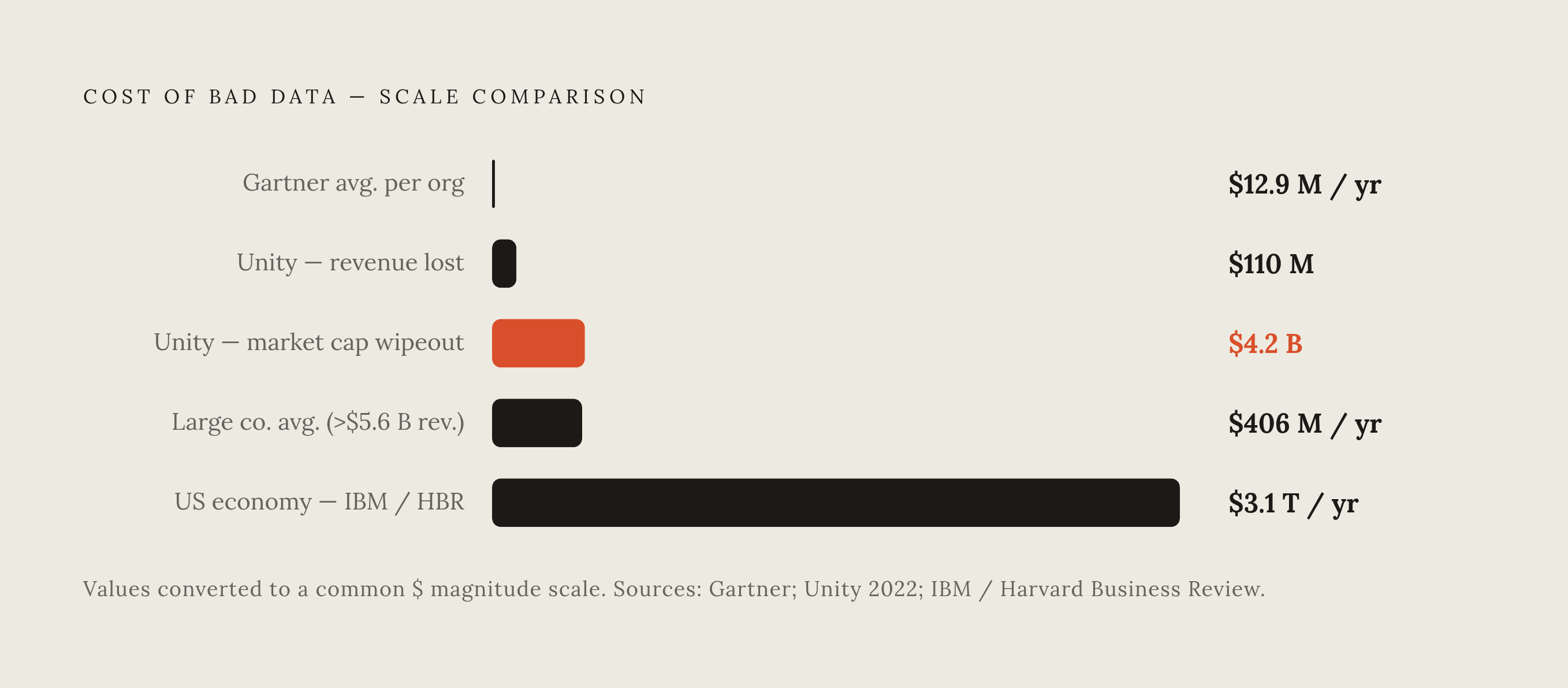
The dollar figures are not small, and they're consistent across sources. The IBM Institute for Business Value found that more than a quarter of organizations estimate losses of several million dollars annually from poor data quality, with 7% reporting losses several times higher still. Gartner puts the average annual cost at $12.9 million per organization. IBM research separately estimates $3.1 trillion in annual losses across US businesses from bad data, and Harvard Business Review has put a comparable estimate at $3 trillion drained from the US economy. Two different measurements landing on the same order of magnitude points at the same systemic wound.
Unity Software is the clearest single case of what this looks like when it hits capital markets. A data quality incident cost the company $110 million in revenue and $4.2 billion in market cap. Investors watched that number happen and priced it into the stock in real time, not months later in a retrospective.
For companies generating over $5.6 billion in annual revenue, the average annual drain from bad data runs to $406 million. That's the actual cost of skipping data quality work, not a hypothetical one, and it should reframe how a CFO reads a line item that says "data engineering."
What data observability requires
Monitoring checks vital signs: predefined metrics tracked against thresholds, flagged when they cross a line. It tells a team when something they already anticipated goes wrong. Observability is the full physical exam, giving real-time insight into data quality, performance, and integrity at every stage of the pipeline, including the failure modes nobody thought to write a rule for.
A working observability practice spans multiple dimensions of the pipeline, covering the freshness, volume, structure, and lineage of data as it moves through each stage. Together they catch structural change and value shift before either one reaches a model or a dashboard, something a fixed checklist can't do by design, because a checklist only watches for the failures someone already imagined. In practice, the metrics that matter include throughput, error rates, execution time, the shape of the data's distribution, and ongoing tracking of schema and semantic drift.
Adoption is accelerating because the cost of skipping it has become too visible to ignore. Gartner projects that 50% of enterprises running distributed data architectures will have adopted data observability tools by 2026, up from roughly 20% in 2024. That gap is widening between organizations that see their data problems coming and organizations that find out the way the bank did, after the false positives start piling up.
How DataOps and AI-Driven Automation Change the Economics of Data Quality at Scale
Observability tells a team what's wrong. Fixing it is a separate job, and that's the job DataOps is built for: the practices and tooling that prevent, catch, and resolve quality failures across the full lifecycle of a data product, rather than at one inspection point near the end.
The productivity gap Gartner projects is stark. A data engineering team operating under DataOps practices will be ten times more productive than a team without them, by 2026. Adoption of data orchestration technology to automate and coordinate workflows across systems is likewise accelerating as enterprises scale their AI programs.
Tooling is catching up to the demand. In September 2025, DataOps.live launched Momentum, the newest version of its DataOps Automation Platform, built to help enterprises operationalize data for trusted AI at scale. It folds automation, collaboration, governance, and observability into a single lifecycle instead of four separate purchases from four separate vendors. That consolidation reflects where the market is heading. Quality can't be a bolt-on step anymore; it has to be structural, built into the pipeline rather than checked at the end of it.
What a reliable data foundation for AI looks like in practice
A functioning modern data stack for AI work tends to include a warehouse layer such as Snowflake or Databricks, transformation through dbt, orchestration via Apache Airflow, and ingestion handled by tools like Airbyte, Fivetran, or dlt. Quality checks run through dedicated tooling, and AI-specific workloads add a vector database (Pinecone, Weaviate, or Qdrant) plus a framework like LangChain or LlamaIndex to manage retrieval and generation.
None of this is monolithic by design, and it shouldn't be. The stack stays modular and cloud-native because flexibility and automation, not tight integration, are what let a team swap a failing component without rebuilding the whole system around it. Tight coupling might look cleaner on an architecture diagram, but it's the reason so many pipelines break in one place and stay broken everywhere downstream.
Quality enforcement has to happen at multiple layers, not once at training time: schema validation when data first enters the pipeline, anomaly detection as it moves through transformation, distribution monitoring once a model is live in production, and lineage tracking that connects every step back to its source. IBM's research on this point lands on something that should reorient how organizations think about AI investment. Organizations with mature data quality and governance frameworks are more likely to move AI use cases out of pilot purgatory and into production, and more likely to sustain the value once they get there. The tools matter less than the discipline behind them. Maturity is the differentiator, and it's the one variable a team can actually control before the model ever sees a row of data.