Data Downtime and Its Effect on Analyst Productivity
Undetected data failures waste analyst time and erode organizational trust in insights.

Data downtime describes a specific failure mode: the data infrastructure is running normally while the information it delivers is wrong, stale, duplicated, or incomplete.
Data downtime versus system outages
A system outage announces itself. Services stop responding, dashboards go blank, alert systems fire, and everyone downstream knows within minutes that something has broken. Data downtime works in the opposite direction: the pipeline keeps running, the table keeps populating, the report renders on schedule, and the number sitting inside it is simply wrong. Nothing in the delivery mechanism signals that failure, because nothing about the delivery mechanism has failed.
None of these conditions stop a system from functioning. They just mean the system is functioning on bad information.
Fivetran's 2026 benchmark report puts a number on how often this happens: enterprises average 60.4 hours of pipeline downtime a month, with organizations experiencing an average of several pipeline breaks over that same period. None of those hours come labeled. An analyst does not receive a notification reading "the figure in front of you is wrong right now." The cost of data downtime is paid first by analysts, in rework and in the credibility they lose when a number they stood behind turns out to be false. The organization often registers that there was ever a problem much later.
How a large, fragile pipeline estate causes silent failures
Data downtime is chronic rather than occasional because the infrastructure producing it is large and brittle by construction. Fivetran's 2026 benchmark reports that enterprises average hundreds of pipelines, maintained by dozens of full-time engineers, a surface area wide enough that incremental, pipeline-by-pipeline fixes cannot keep pace with the rate of new breakage. Legacy and homegrown pipelines break materially more often than managed ones, and most enterprises still depend heavily on exactly that layer.
The mechanism that makes this dangerous is propagation. Without continuous monitoring across that pipeline estate, a schema change at one source does not stay contained to the system where it originated. It moves downstream silently, breaking a transformation, until an analyst looking at a report sees a number that is simply incorrect, with no indication of where in the chain the error entered. The invisibility of data downtime is what makes it so costly: the pipeline runs, the data loads, the analyst sees a number, and nothing in the system tells them it is wrong. AI-powered data reliability platforms, including Quill, are built around that gap, continuously monitoring for duplicates, missing fields, and stale records so analysts have a signal of what can be trusted before they build anything on top of it.
Given hundreds of pipelines and a failure rate that climbs with legacy infrastructure, some share of the estate is very likely broken at almost any given moment. It is a standing condition analysts have to work inside. No analyst can treat the data in front of them as reliable by default. Verification becomes a precondition for every task, including the low-stakes ones.
Where analyst time goes when data cannot be trusted
Analysts feel the consequence of operating inside that condition directly in how they spend their days. Forrester research finds that nearly a third of analysts spend more than two-fifths of their working time vetting and validating data before they can use it for any strategic decision. It is reactive triage instead: checking whether a revenue figure matches what it should be, tracing a discrepancy back through a chain of transformations, deciding whether a flagged anomaly is worth escalating or simply working around.
The work displaced by that triage is the work analysts were actually hired to do: building models, surfacing insights, advising the decisions the business is waiting on. Every hour spent confirming that a number can be trusted is an hour not spent turning that number into something useful. And the displacement is invisible to the people managing these teams, because an analyst spending the morning validating a revenue figure does not look unproductive. They look occupied, engaged, working. The real cost sits in what never got built, which is much harder for a manager to notice than a missed deadline.
Teams that have layered AI on top of this environment feel the tax more acutely, not less. ISG's research found that enterprises already consider data usability a significant challenge for AI applications, and that teams spend the majority of their time cleaning data rather than building models. The ratio inverts: time that should go toward building the thing goes instead toward making sure the thing being built isn't standing on broken ground.
Firefighting bad data as the data team's default mode
That individual tax multiplied across an entire team shifts the organization's posture. Fivetran's 2026 benchmark puts a number on it: data teams dedicate 53% of engineering time to maintenance, with millions of dollars spent annually by full-time engineers specifically on keeping pipelines running. That is budget and headcount that cannot simultaneously fund anything new, because it is already spoken for by the task of keeping what exists from breaking further.
The downstream effect is measurable in delivery timelines. Nearly a third of organizations report analytics and AI project delays of a month or more, driven directly by maintenance consuming the capacity that initiative delivery was supposed to draw on. The same benchmark shows what the alternative looks like: organizations that are not locked into heavy maintenance deliver analytical products faster, run more AI experiments, and are nearly twice as likely to report that their data investments exceed ROI expectations, because less of the team's time is spoken for before any strategic work begins.
The Target Canada case shows what happens when that dynamic is allowed to run unchecked long enough. The failure began at the operational layer, in data that nobody caught in time, and ended as a business-level crisis. Most organizations never experience a failure at that scale, but the slower version of the same dynamic plays out constantly in teams known internally as the group that fixes data problems rather than the group that drives insight. That reputation caps what the function is ever asked to do.
How the trust breakdown spreads from analysts to decision-makers
The damage does not stay contained inside the data team once it takes hold. It moves upward, into the rooms where decisions actually get made. A KPMG study finds that only about a third of organizations report high trust in their use of data and analytics. Most leadership teams are making calls with low confidence in the numbers their own analysts hand them.
That low confidence produces predictable behavior. Executives call reconciliation meetings to settle which version of a figure is correct before a decision can proceed. Approvals stall while teams argue about whose source is authoritative. Leaders quietly ask for "the real numbers" from whichever source they happen to trust more, bypassing the official one. None of this looks like a pipeline failure. It is a human process built to compensate for a reliability gap that originated in the data layer, and it consumes senior time at a rate that never appears in any downtime log.
The 2022 case of a real-time 3D content platform shows how fast that erosion can move. A fault in its Audience Pinpointer machine learning tool combined with bad data ingested from a large customer, which corrupted the training data feeding the tool, and the two compounding issues escalated into a disaster that sent the company's stock sharply lower. Investor confidence and internal confidence in the data collapsed together, because once the reliability of the underlying numbers is in doubt, every downstream judgment resting on those numbers is in doubt as well.
The dollar cost of lost hours
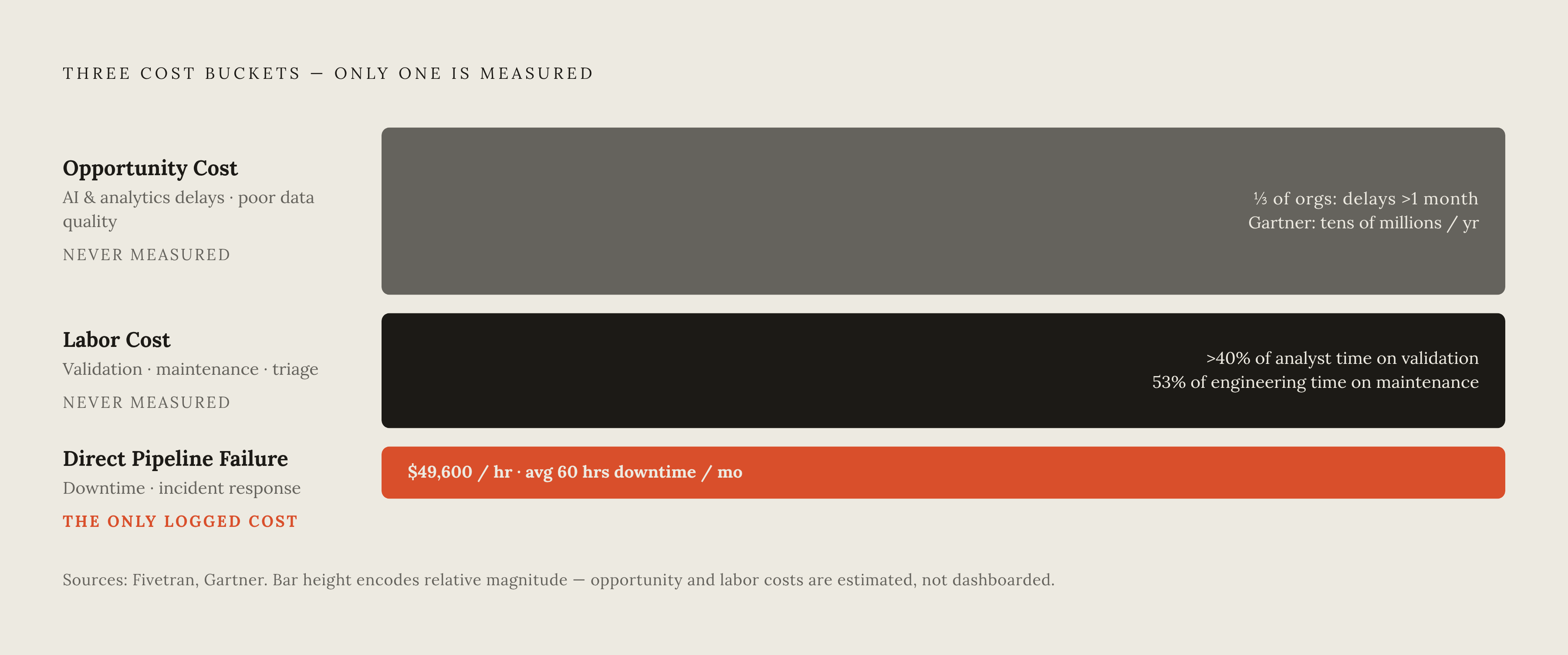
Fivetran's benchmark estimates the business impact of downtime at roughly $49,600 per hour, which pushes the monthly exposure from known downtime hours into the millions and the annual figure well into the tens of millions. Splunk's 2026 Hidden Costs of Downtime research, conducted with Oxford Economics, puts the average cost per minute for Global 2000 companies at a figure that has climbed sharply over two years, tracking how dependent operations have become on data systems staying reliable.
Those figures already describe serious money, and they still only capture the visible half of the problem: declared incidents and measurable pipeline failures. The productivity tax described earlier, analyst validation time, reconciliation meetings, delayed AI initiatives, does not appear in those calculations at all. The full cost is the sum of three things that almost never land on the same dashboard: direct pipeline failure cost, the labor cost of reactive human triage, and the opportunity cost of strategic work that simply never happened. Gartner's estimate that poor data quality costs organizations tens of millions annually likely captures only a slice of that third category.
IBM's research puts the macro scale at trillions of dollars annually for U.S. businesses, a figure large enough to feel more like an abstraction than a budget line. But the mechanism producing that total is simple arithmetic: thousands of individual organizations, each underestimating its own exposure, added together. The underestimation is structural rather than accidental. Analyst time spent validating data appears in headcount cost, not in any line item labeled "data quality." Project delays are visible in project management reports, not in downtime logs. Executive reconciliation meetings consume senior time that no log captures. The anchoring figures above, the per-hour estimate and the Splunk per-minute figure, are already large. They function as a floor on the true cost, not a ceiling.
Why AI deployments make unresolved data downtime more dangerous
Everything described so far intensifies once AI takes over more of the workflow. In an environment where AI runs across revenue and go-to-market processes, data downtime becomes an input quality problem: AI systems reinforce and scale the errors in the data rather than simply surfacing them for a human to catch.
A model trained on flawed CRM or RevOps data does not respond to that flaw with appropriate uncertainty. It produces confident wrong answers. Lead scores built on duplicate contact records misprioritize accounts that look more active than they are. Revenue forecasts built on stale contact data misproject pipeline that no longer reflects reality. As the model continues training on that same data, it grows more confident in the outputs it has already gotten wrong. Research across the field finds that a large majority of AI and machine learning projects fail specifically because of data accuracy problems, and that teams already spend most of their time cleaning data rather than building models, which inverts the ratio of productive to preparatory work that AI investment was supposed to deliver. Gartner has projected that at least 30% of generative AI projects will be abandoned after proof of concept, citing poor data quality alongside inadequate risk controls, escalating costs, and unclear business value as the drivers.
Fivetran's 2026 benchmark confirms the pattern at scale: most organizations rate their own data maturity as low even as they continue expanding their AI ambitions. CRM and RevOps systems carry this risk especially hard, because those systems feed automated workflows, not just dashboards an analyst might review before acting on them. A bad account record that a human analyst would catch and flag gets processed without review by an AI workflow instead, triggering a misrouted lead, an incorrect piece of outreach, or wrong attribution, all at machine speed and machine scale. Without continuous, automated monitoring across a pipeline estate this large, a schema change upstream breaks a transformation silently, and the first person to notice is an analyst three steps downstream staring at a number that cannot be right. Data downtime that once taxed analyst productivity now taxes every AI-dependent process built on the same foundation, and that tax grows with each new deployment layered onto infrastructure that was never made reliable in the first place.
Why alerting alone cannot fix this
Monitoring tools that flag data quality issues and route the alert to a human analyst feel like progress, but they do not remove the productivity tax described throughout this piece. They relocate it, trading validation time for triage time while leaving the actual fix in human hands. That logic assumes there is slack capacity sitting somewhere in the analyst's schedule, ready to receive an alert, investigate it, and resolve it. The research above says otherwise: analysts are already spending a substantial share of their working hours on validation before a single alert arrives, and adding more alerts to that queue adds load rather than relief.
The architectural response has to close the loop that alerting leaves open. Agentic systems that detect anomalies and propose fixes autonomously, rather than waiting on manual triage, are built to keep pace with the scale and fragility of a modern pipeline estate in a way that human review alone cannot. Automating the work of validation, rather than simply alerting a team after a problem has already surfaced, is what lets analysts reclaim the hours currently lost to reactive triage. When a fix can be proposed and applied without waiting on a person to pick it up, the triage tax stops accumulating, and the analyst returns to the work the role was created for: building the models, finding the insight, and giving the business a number it can actually stand behind. AI is not a separate concern here but the multiplier on it: everything argued above becomes more consequential as AI takes over more of the workflow. As enterprises hand more of the workflow to AI, the stakes of leaving this loop open rise accordingly, since unresolved data downtime becomes significantly more dangerous to AI deployments.
For teams choosing between approaches, the criteria that matter are whether detection runs continuously rather than on a schedule, whether the system proposes a remediation rather than only a flag, and whether it covers the CRM and RevOps layer where duplicate and stale records do the most damage. Vendors in this space vary in how much of that loop they close. Quill is one option built specifically around closing it end to end, from detection through proposed fix, rather than stopping at the alert.