Why Alerting on CRM Data Problems Is Not the Same as Fixing Them
Autonomous systems that continuously fix data problems beat alerts that only flag them.
CRM hygiene is not a problem alerts can solve. The shortlist of what actually works, in order of maturity: rule-based validation at entry (helps marginally, addresses none of the decay that happens after entry), alerting and dashboards (creates visibility without resolution), scheduled manual cleanup sprints (temporary, and the CRM returns to its prior state within months), and autonomous remediation systems that propose and apply evidence-based fixes continuously, with human review calibrated to the risk of each fix. The rest of this piece explains why the first three approaches have a structural ceiling, and what the fourth looks like in practice.
CRM data problems versus pipeline problems
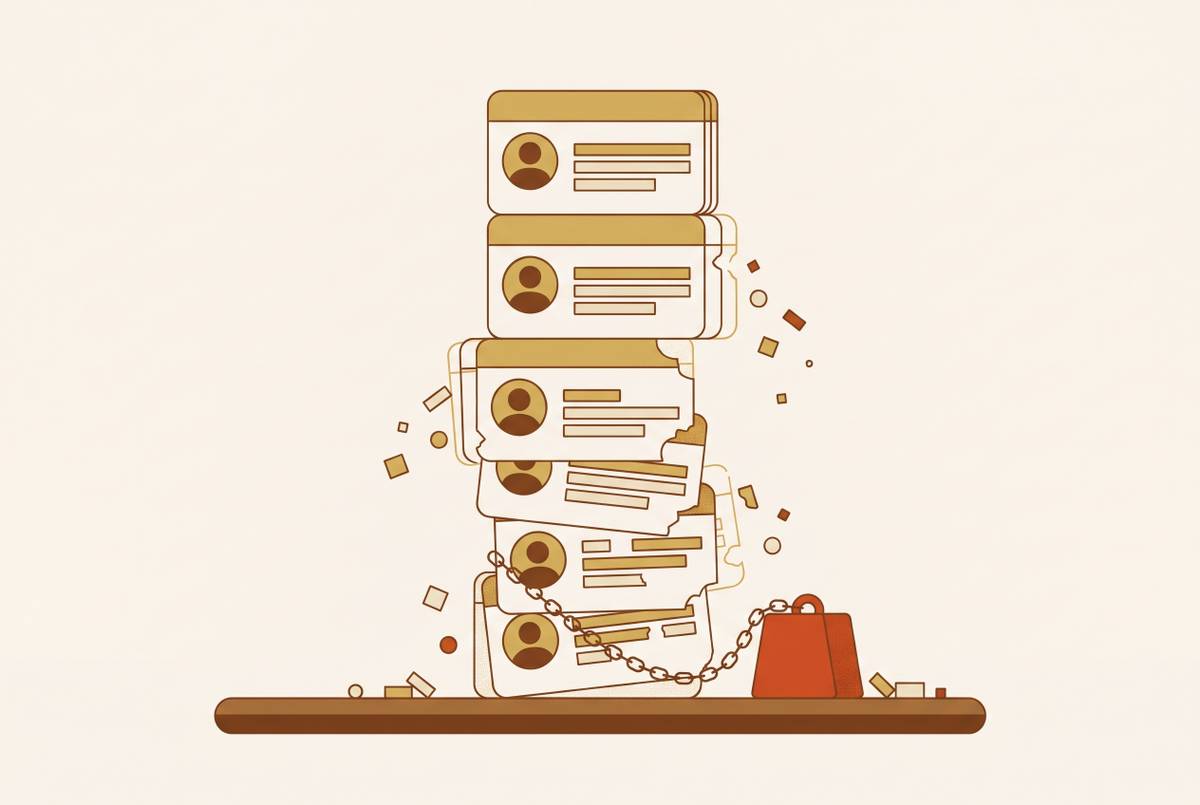
A pipeline failure is an event. CRM data failures are not events. None of these moments produce a clean signal. They produce a slow accumulation of small inaccuracies that only become visible once they've compounded into something expensive.
B2B contact data decays continuously as people change roles, companies merge, and teams reorganize, and no alert is designed to catch that kind of gradual drift. The alert marks the moment the damage became measurable, not the moment it began.
CRM data quality is also multidimensional in a way pipeline health rarely is. A rule written to catch one dimension says nothing about the other two, and the failures compound rather than add.
The reason this matters beyond data hygiene for its own sake: the CRM is the system of record for revenue decisions. An error in one field doesn't stay contained in that field. It flows into every process and every team that touches the record downstream, which is precisely the structural trait that distinguishes CRM data problems from a failed pipeline job sitting in isolation until someone reruns it.
The illusion of control created by alerting on CRM data
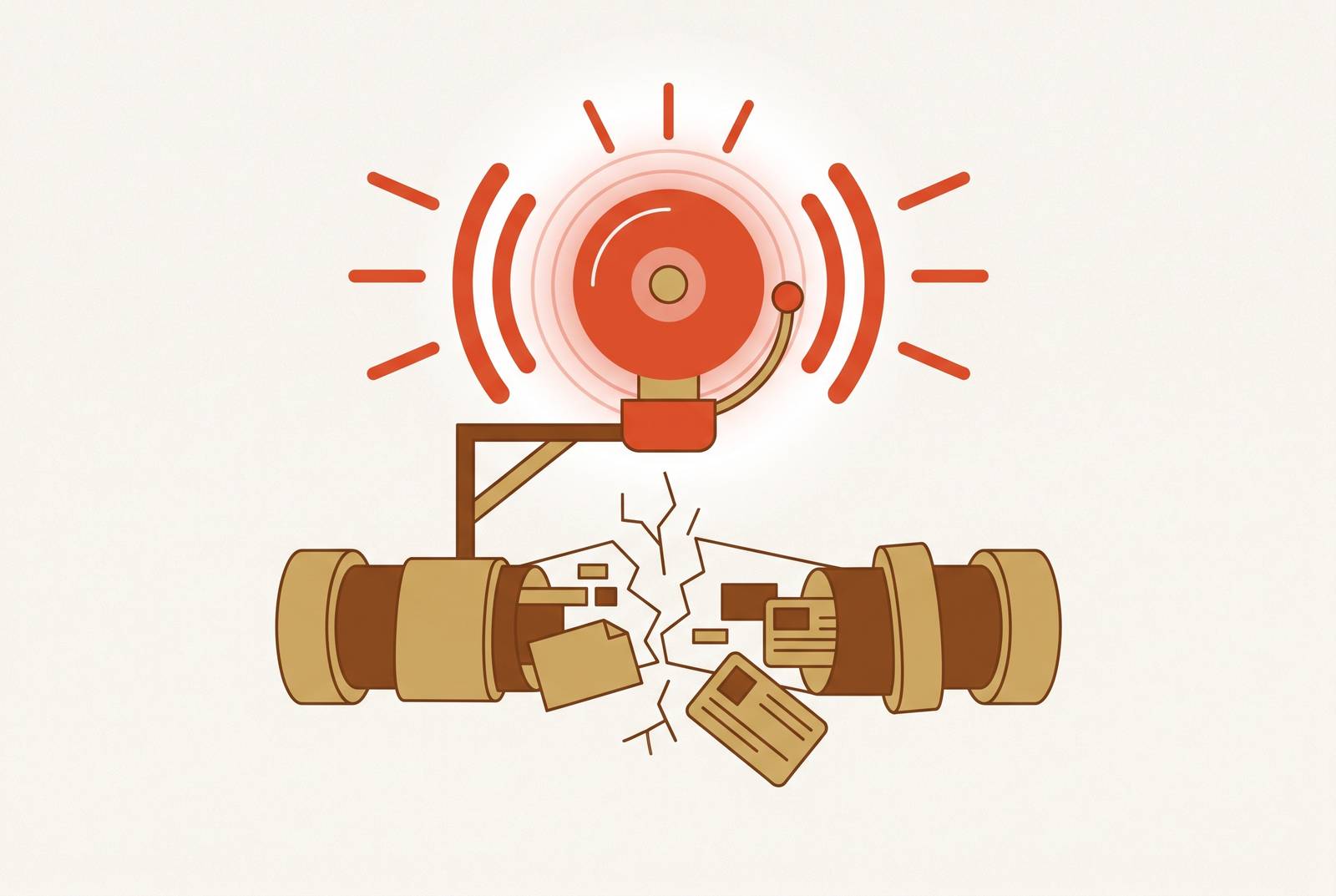
An alert system is built to answer one question: did something cross a threshold? That question is too narrow for a data environment where the problems that matter most are distributed across records, slow to develop, and often invisible until they've already cost money.
Consider what a basic alert can and cannot see. Accuracy and timeliness, the dimensions that actually determine whether a forecast or a scoring model can be trusted, are the hardest to encode as a simple rule and the most often skipped.
The result is a monitoring posture that fires constantly on low-value signals while the compounding problems that actually damage revenue go unflagged for months. Someone now has to triage it, investigate what actually happened, reproduce the conditions that caused it, and decide on a remediation, and every one of those steps takes time during which the CRM continues operating in its broken state.
Validity's State of CRM Data Management report found that more than a third of CRM users reported losing revenue as a direct consequence of poor data quality. A team can have a hundred rules running and still be losing revenue to problems none of those rules were written to see.
Agentic data reliability platforms, among them Quill, are built on the premise that alerting cannot distinguish a low-risk signal from a compounding one, because alerting only surfaces what crossed a threshold, not what actually matters to the business reading the record. Closing that gap requires moving past notification into autonomously proposing and applying evidence-based fixes, rather than leaving a human to triage a queue that keeps refilling faster than it empties.
What the gap between detection and resolution costs
A detection-only program becomes expensive in the interval between when the problem could have been caught and when someone actually fixes it, an interval that, for CRM data, is often measured in months.
A single duplicate account record shows the mechanism clearly. Two records for the same company exist because a rep created a new one instead of searching for the existing entry, or because two integrations fed in slightly different company names. From that moment, the account's activity history splits across both records. One bad record, uncorrected, raises separate costs in sales, marketing, data science, and finance, and because none of those costs appears as a single line item anywhere, the true cost of dirty CRM data is so often underestimated.
The anatomy of the spread follows a predictable path: a single bad field entered at lead creation gets multiplied by marketing segmentation, then by SDR outreach built on that segmentation, then by AE qualification built on the SDR's notes, then by forecast rollups built on the AE's stage updates, before finance builds a board deck on top of the rollup. The damage does not accumulate in a straight line. It multiplies at each handoff, because each team downstream treats the record as ground truth.
Sales reps spend a measurable share of their working hours reconciling records and chasing down what a field should actually say, time taken away from selling. That is the most expensive consequence of unresolved CRM data problems and the least visible one, because by the time it reaches the board deck, the chain of causation looks nothing like a single duplicate account from six months earlier.
Why AI deployment makes the detection-resolution gap dangerous
Every one of the costs above assumed a human somewhere in the loop, slow, but at least capable of catching an obviously wrong number or a strange-looking forecast before it propagated further. AI deployment removes that pause. A detection-only program that was expensive under a manual workflow becomes something closer to a liability once agents start acting on CRM data at machine speed.
In a manual workflow, a rep who noticed a wrong phone number fixed it on the way past, and a sales manager reviewing a forecast that looked off asked questions before it reached the board. The agent does not pause to wonder whether the data it was given was accurate. It acts on it, at scale, immediately.
A meaningful share of organizations have moved to deploy generative AI across their revenue operations while a large share of CRM users report that their underlying data is not ready for that kind of deployment. That gap between how fast AI is being adopted and how fast the data underneath it is being made trustworthy is where the structural risk actually sits. It is the condition under which most AI-on-CRM deployments are currently operating, not a hypothetical risk.
The CRM functions as the foundation for lead scoring, routing, forecasting, and pipeline reporting, and any AI model trained on or acting on top of that foundation inherits every quality failure already present in it, then amplifies those failures across every system the model's output touches. That is the mechanism behind what researchers in adjacent fields have described as confident nonsense: AI systems producing fluent, decisive output built entirely on a foundation the system itself cannot audit. Organizations are deploying AI faster than they are fixing the data that AI depends on, and the gap between detection and resolution widens precisely as the cost of leaving that gap open keeps growing.
Why standard remediation responses to CRM data alerts don't scale
Every response available to a detection-only program, assigning a person to triage, running a manual cleanup pass, scheduling a quarterly hygiene sprint, depends on human throughput, and human throughput cannot keep pace with how fast CRM data actually degrades.
The degradation starts so early for cultural reasons as much as technical ones. CRM data entry is treated across most revenue organizations as an administrative task bolted onto a rep's real job, rather than as a function that enables the rep's own sales process. Reps log a fraction of their actual sales activity into the system. The CRM starts accumulating gaps at the moment of entry, not gradually over the following year.
Manual entry errors, natural data decay, integration mismatches between connected systems, absence of validation at the point of entry, and no clear ownership over who is accountable when a record goes wrong are the five root causes of most CRM data quality failures. A quarterly cleanup sprint touches none of these causes directly. It touches their symptoms, the duplicate records and stale fields that resulted from them, and because the causes are untouched, the same categories of errors reappear within months, often before the next sprint is even scheduled.
The alert-triage-fix loop has a hard throughput ceiling. One person, or one small team, can resolve a finite number of data issues in a working day. CRM data does not degrade in daily batches that match that capacity. It degrades continuously, around the clock, regardless of whether the queue assigned to fix it is empty or backed up three weeks.
A reasonable objection holds that better validation rules at the point of entry would prevent much of this from happening in the first place. Validation prevents some new errors. It remediates none of the existing ones.
Autonomous remediation and human review
Closing the gap between detection and resolution requires giving a system the authority to act, not just to notify. Autonomous does not mean unaccountable: the architecture that works separates decisions an agent can make on its own from decisions that require a human to approve first, and that separation is based on how reversible and how consequential each fix actually is.
A useful way to think about the spectrum: at one end, notify-only, where an agent identifies a problem and logs it for a human to act on, which is functionally identical to today's alerting model. One step further, suggest, where the agent proposes a specific fix along with the evidence behind it and waits for a human to approve before anything executes. At the far end, autonomous, where the agent applies the fix directly and logs the decision and its supporting evidence for later audit. Different categories of CRM problems warrant different positions on that spectrum, and treating all of them identically, either by automating everything or by routing everything through a human, wastes the advantage the architecture offers.
The governance objection deserves serious consideration. Autonomous remediation inside a CRM is not like retrying a failed pipeline job. A pipeline retry that goes wrong can usually be rolled back cleanly. A fix applied to a live CRM record can change an open deal, alter a customer relationship, or touch legal consent data, and some of those changes cannot simply be undone once they've propagated to the systems reading from that record.
The answer is to match the degree of autonomy granted to the reversibility of the action being taken, rather than to reject automation on the strength of that risk. Approval-based autonomy, where the agent acts on a record only after a human has confirmed the specific fix, preserves the speed advantage of automation for the high-confidence, low-risk cases while keeping a person in the loop for anything consequential enough to warrant it.
None of this works without a complete audit trail. Closing that specific gap, between volume of problems and throughput of resolution, is the entire argument for agentic over purely observational architecture.
RevOps teams restructuring around data reliability as an operational metric
The organizations making real progress on this problem are not just adopting new tooling. They are changing who is accountable for data reliability and what that accountability is measured against.
A growing practice among RevOps leaders is to report a Data Integrity Score directly to the CRO, alongside the standard pipeline metrics, measuring CRM completeness, accuracy, and consistency as a single rolled-up figure the same way a CRO already tracks win rate or average deal size. That single change moves data reliability out of the technical backlog and into a revenue leadership concern, reviewed at the same cadence and with the same scrutiny as the forecast itself.
If a bad account hierarchy or a stale deal stage costs pipeline, the people who own the pipeline number are the people who should own fixing the data that produced it, not a data team several steps removed from the deal.
The architecture that closes the gap: agentic, not observational
A data reliability program that stops at observation is incomplete by its own design. Detection without resolution assumes a human downstream will always be available, fast enough, and attentive enough to act on what was found, an assumption that CRM data has never actually supported.
CRM data carries none of those properties. Its problems are continuous rather than discrete, span multiple dimensions of quality at once rather than tripping a single rule, and touch records that are actively driving live business processes the moment they go wrong. An alert queue built on infrastructure logic will keep growing faster than any human team can clear it, because the rate of decay was never bound by the rate of human attention in the first place. Closing that gap requires an architecture where detection, diagnosis, and remediation happen inside the same system, evidence gathered and a fix proposed or applied without a mandatory hand-off at every step. That is the shift from alerting to agentic reliability, and it is the only architecture built to match the pace at which CRM data actually breaks.