Enterprise CRM Deduplication and Hierarchy Vendors Evaluated Against Real Data Debt
Test deduplication vendors against your actual data, not their polished demos.
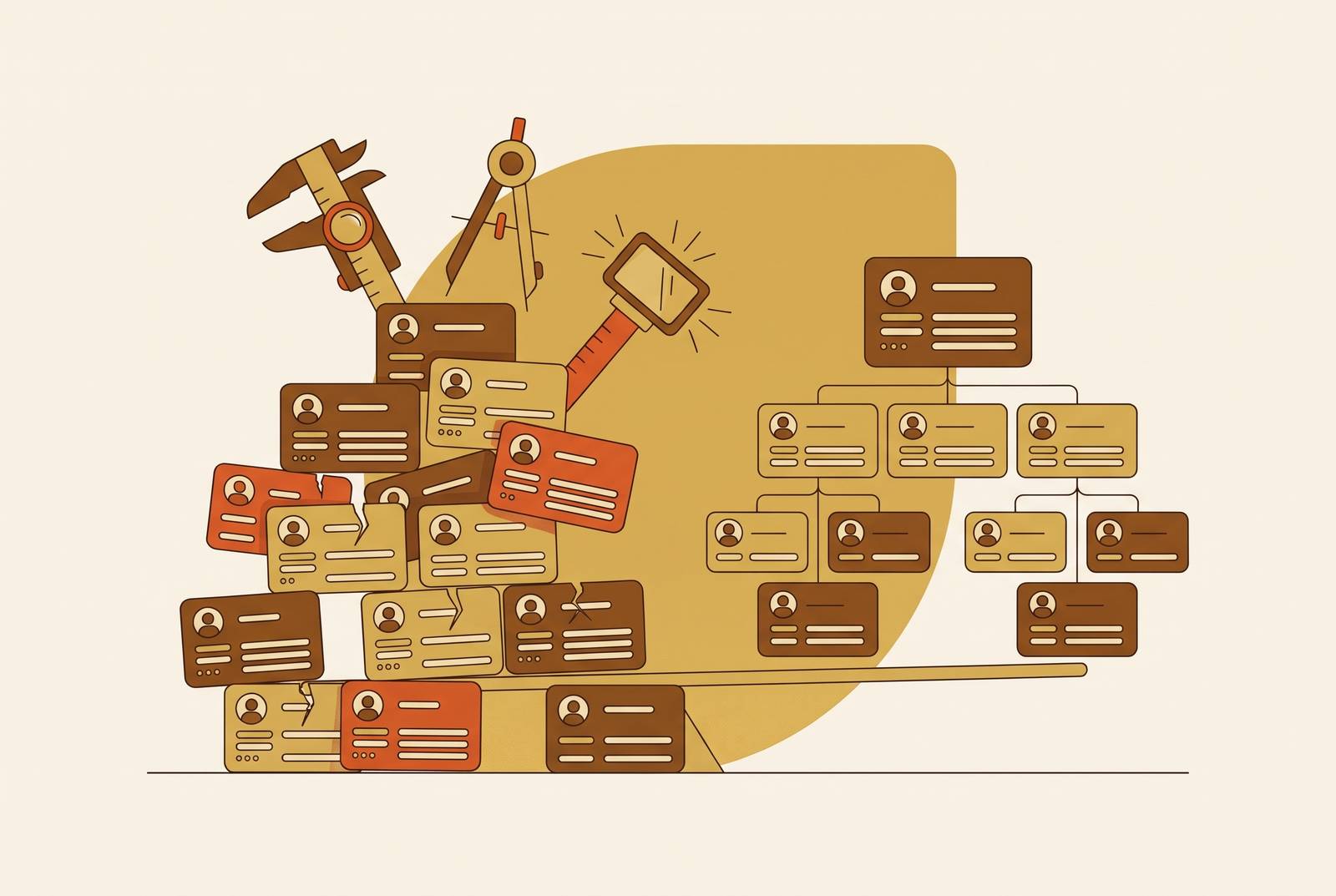
CRM hygiene is the ongoing work of keeping CRM records accurate, separate from one another, and linked in the right way across connected systems. Enterprise deduplication and hierarchy vendors should be evaluated against production data debt. Removing duplicate contacts safely calls for matching logic that fits the actual records, rules that govern merges, and checks that prevent and spot duplicates as new data comes in.
Why demo-day performance is the wrong way to evaluate CRM deduplication vendors
A rep finds three open opportunities for the same account, each sourced differently. The rep must determine which records belong together without losing the context attached to each opportunity. A demonstration with clean fields, names that follow the same pattern, and records shown on their own cannot test that decision.
The mismatch begins with the demonstration dataset. Curated examples remove the ingestion history and integration-driven variation that make enterprise deduplication difficult. They also conceal enrichment conflicts, where different providers supply competing values and last-write-wins logic determines what survives. A successful demo therefore establishes only that a tool can handle the examples it was shown.
The three data debt conditions that expose vendor capability gaps
Can the vendor recognize the same entity when web forms, API syncs, manual entry, and third-party imports produce different names and formats? Each channel introduces its own variation. A pilot must test those channels together rather than treat exact email matching as sufficient evidence of capability.
The second question concerns continuous decay. Does the tool prevent creation and detect duplicates in real time, or clear a backlog that starts rebuilding immediately? B2B contact data changes continuously, so records cleaned at implementation can diverge again within months. Scheduled cleanup alone leaves the intervening period exposed. This shows whether a point tool can keep data clean or a platform is needed to do so without an admin stepping in again and again.
Can the vendor distinguish a parent from its subsidiaries and address duplicate records propagated through integrations? A shared domain does not establish a shared entity. The test must also include conflicting enrichment values, because a field can still have a valid structure even as the last job to run changes what it means for the business or whether it is accurate.
Where CRM-native deduplication reaches its ceiling under real data debt
Salesforce, HubSpot, and Zoho provide a reasonable starting point for smaller, low-volume, single-source environments. Salesforce Help specifies five active duplicate rules per object and five active matching rules per object. Salesforce supports configurable real-time cross-object alerts, including Lead-to-Contact, but its batch Duplicate Jobs do not provide cross-object detection.
Bulk remediation creates a separate constraint. Salesforce has no native bulk merge or auto-merge capability and no merge functionality for custom objects. Salesforce and Zoho limit manual merges to three records at a time, while HubSpot merges one pair. Native merges are permanent and have no rollback, so teams need to understand the downstream context before combining records.
Coverage also differs by platform and object. HubSpot provides AI-assisted duplicate management and property suggestions, with deduplication coverage centered on contacts and companies and limited for deals. Zoho lacks native fuzzy matching, leaving variant spellings and formats outside that capability. These tools address baseline prevention, but multi-source variation, bulk volume, and cross-object complexity exceed their native scope.
How purpose-built Salesforce deduplication platforms perform where native tools stop
Plauti tackles ingestion-driven inflation with rules for each object and scenario, merge criteria for each source, and pilots run country by country. Plauti’s enterprise guide describes bulk jobs that process millions of records, with a large-data-volume option. Real-time creation and update checks, plus import and API screening, address recurrence. Governance is built into the approach. Processing stays inside Salesforce and follows sharing rules and field-level security, so changes can be audited and reversed, but it does not resolve contamination across the whole connected stack.
DemandTools emphasizes granular admin control through matching, merging, normalization, and mass updates. That toolkit addresses an inflated backlog and gives teams detailed control over cleanup. Keeping up with continuous decay still takes work, however, because manual processes can keep drawing admins back in. Its primary Salesforce focus, with limited support for Microsoft Dynamics 365 and other CRMs, also constrains its role as a cross-system answer.
DataGroomr uses an AI-first approach that needs little configuration at the start. DataGroomr says matching gets better as people use it, including when they accept or reject suggestions. This favors quick deployment against duplicate inflation. The trade-off is less configurability for complex multi-object or multi-country requirements, and improved matching alone does not establish prevention or control of downstream contamination.
Cloudingo addresses a different production risk through undo-and-restore capability in its Professional tier. That improves merge safety, but rollback does not by itself demonstrate continuous decay control or cross-system coverage. Sweep’s analysis addresses the dependency side by mapping fields, objects, and automation and surfacing downstream impact before production changes. Its emphasis is ongoing system governance, complementing record matching with context about what a merge will affect.
Cross-CRM and multi-stack deduplication — where single-platform tools break down
When a bad CRM record reaches marketing automation, cleaning its source does not establish that the connected environment is clean. The scope changes again after a merger involving two CRM platforms. Salesforce-only processing cannot follow every affected record. RingLead, now part of ZoomInfo Operations, addresses this prevention problem with real-time duplicate detection, although complex matching is less flexible and its scope is limited beyond CRM use cases. Pricing is custom.
Insycle addresses recurring cleanup across Salesforce, HubSpot, Pipedrive, Intercom, Mailchimp, Marketo, Zendesk, and Yext. It combines flexible matching and master-record selection with field standardization, previewed bulk merges, and scheduled workflows for contacts, companies, and deals. Insycle holds SOC 2 Type II certification. Its low monthly cost for a mid-size record database fits different buyers from those who need a heavily configured enterprise deployment, though how it handles records between scheduled runs is still an open question.
Limits on where tools can run can decide which vendor tier fits. WinPure provides on-premises deduplication without sending sensitive records to external APIs, addressing constraints in healthcare, finance, and government. Its annual pricing starts at an accessible entry point for small teams. TIBCO Clarity instead offers enterprise cross-system quality and matching with strong governance support, but a more complex setup and higher learning curve.
Deals, activities, and notes reattach to the surviving master, and deleting the wrong record first can permanently orphan history. Parent accounts must therefore precede child contacts.
Account hierarchy data providers and where domain matching fails
Hierarchy resolution is not another name for deduplication. Two records may represent distinct entities that belong in the same corporate family. The account definition must come first. Teams need to decide whether an account represents a legal entity, brand, regional operating company, or selling unit, then record its parent relationship separately. Otherwise, a technically correct domain match can still place an opportunity on the wrong subsidiary.
Dun & Bradstreet addresses reconciliation across countries, systems, and reporting levels. Its D-U-N-S identifier is a business key that stays the same through name changes and rebrands. Coverage depends on the product version. Corporate Linkage Standard returns the direct line to the global ultimate, while Enhanced returns the ultimate parent and all related entities in the family tree. That distinction is consequential for buyers mapping subsidiaries.
ZoomInfo offers deep US contact and company data, hierarchy mapping, and job change alerts. Its ownership of RingLead creates a combined enrichment-and-deduplication path for Salesforce and marketing automation environments. For global buyers, that US strength makes international coverage a pilot scoping question. Data Ladder’s DataMatch Enterprise contributes entity resolution, fuzzy matching, record linkage, and address verification, which support hierarchy resolution but do not replace the need to establish corporate relationships through external data.
The matching logic gap that determines whether a vendor actually finds your duplicates
“Fuzzy matching” does not identify a single capability. Two tools with that label can have different recall because each field type needs its own way of comparing values. Levenshtein catches typos in short identifiers, while email and phone fields need normalized exact comparison. Thresholds must also fit the dataset. The algorithm-to-field assignment is therefore a more useful evaluation criterion than the feature label.
“Acme Inc.”, “Acme Corporation”, and “ACME” illustrate the gap. Those names describe variation that cannot be exhaustively enumerated in rules at enterprise scale. AI can help identify patterns that configured rules miss, but unexplained recommendations create an audit problem. Plauti’s guide proposes defining business and compliance matching requirements first, then using AI to prioritize likely duplicates, explain their relationship, and propose field-level outcomes.
The practical buyer test is consequently straightforward. Before shortlisting, load a representative extract containing actual duplicates and malformed rows, and ask which algorithm applies to each field type. Use that extract to test recall rather than a demonstration set supplied by the vendor.
How do you keep CRM data clean and accurate over time?
Scheduled deduplication leaves gaps between runs as new records come in and contact data keeps changing. Continuous monitoring makes those gaps visible, but structural checks alone are insufficient. A field can pass freshness, volume, distribution, and schema checks while its meaning shifts from “account active” to “contract pending renewal” after a workflow change. Nothing about its structure has moved. Reliability therefore requires attention to business meaning as well as the shape and arrival of data.
Monitoring and correction perform different jobs. A monitor can report a spike in duplicates, while a reliability platform prevents creation, detects in real time, and merges in small governed increments. Sweep’s analysis highlights the amplification risk from Agentforce, Einstein, and enterprise copilots acting on CRM data. An alert can arrive after downstream AI has already ingested the bad records, making delayed human triage insufficient as the sole response.
Agentic data reliability addresses that timing mismatch. Agents that can find, propose, and apply fixes autonomously operate at the pace of the systems generating data debt without waiting for an admin to restart cleanup. Autonomy does not remove the governance requirement. Matching criteria, merge rules, and dependency context keep continuous correction under control so that faster changes also follow the rules.
How to run a real-data-debt evaluation before signing a vendor contract
The first step is to define the account model. Specify whether each account represents a legal entity, brand, regional operating company, or selling unit, and document the parent relationship separately. Then confirm which hierarchy tier the vendor resolves. Without that definition, a pilot can reward matches that are technically consistent but wrong for the business.
The second step is to build a dataset from production data. Include every ingestion source, known duplicates, malformed rows, enrichment conflicts, and parent-subsidiary cases with variant domains. Preserve the difficult cases. They reveal whether the tool handles the actual debt rather than the subset most convenient to demonstrate.
The third step is to score the three conditions. Measure duplicate recall on the pilot set and ask the vendor to disclose its algorithm-to-field assignments. Establish whether decay control runs in real time or on a schedule, including what happens between runs. For contamination, test whether the tool can detect and act on duplicates created through both integration sync and manual entry.
The fourth step is to test merge safety. Confirm rollback capability instead of assuming that third-party tooling makes every merge reversible. Map the flows, reports, and integrations affected before running changes, and test parent-before-child sequencing. A correct duplicate match is not sufficient evidence that its merge is safe.
The fifth step is to evaluate the monitoring posture. Check whether keeping data clean means an admin must step in again after each backlog is cleared. Does the vendor’s architecture alert after the fact, or prevent and resolve data debt continuously?