What Automatic CRM Record Repair Actually Does to Your Data Debt Ledger Over Time
Automatic repair slows data debt's spread, but only sustained governance prevents it from returning.

CRM hygiene is the ongoing work of keeping CRM records accurate, complete, current, and free of duplicates. Automatic CRM record repair reduces data debt by shortening the time an error can generate further errors. Its lasting value depends on governance that controls repairs and addresses the processes that keep producing bad data.
How CRM data debt accumulates and why it accelerates over time
Financial debt compounds when unpaid interest generates new interest. CRM data debt compounds when unrepaired errors generate new errors. A bad record is both a liability and a source of further liabilities because other records and decisions depend on it. Even when no one makes new entry mistakes, contact data changes as people move between roles and companies. Job titles alone turn over at 65.8% annually in CRM databases.
A stale contact record produces a bounced email, which degrades sender reputation and suppresses delivery to valid contacts. When fewer messages get delivered, fewer replies get logged, leaving an opportunity cold with nothing in its history to explain why. That opportunity then distorts pipeline reporting, and the distorted report can lead to misallocated headcount. What began as one stale contact has affected otherwise valid records and decisions.
Validity’s 2025 CRM report surveyed 602 CRM users and stakeholders and found that a significant share reported losing revenue directly because of poor data quality. The finding shows that CRM hygiene is part of both revenue operations and database administration. Across the funnel, bad contact data feeds corrupted lead scoring, misdirected routing, and unreliable forecasts. The ledger therefore grows through two channels. New errors enter the system while old ones spread through the records and decisions that depend on them.
What happens to the ledger when errors go unrepaired for months and years
Over months, that spread changes the nature of the debt. An incorrect field may still be easy to correct, but the decisions built on it become harder to trace. Meanwhile, reps trust the system a little less each week, and managers are less willing to believe the pipeline report. Trust becomes another source of decay. Reps stop maintaining records they no longer believe in, and every unlogged call makes the next record harder to trust.
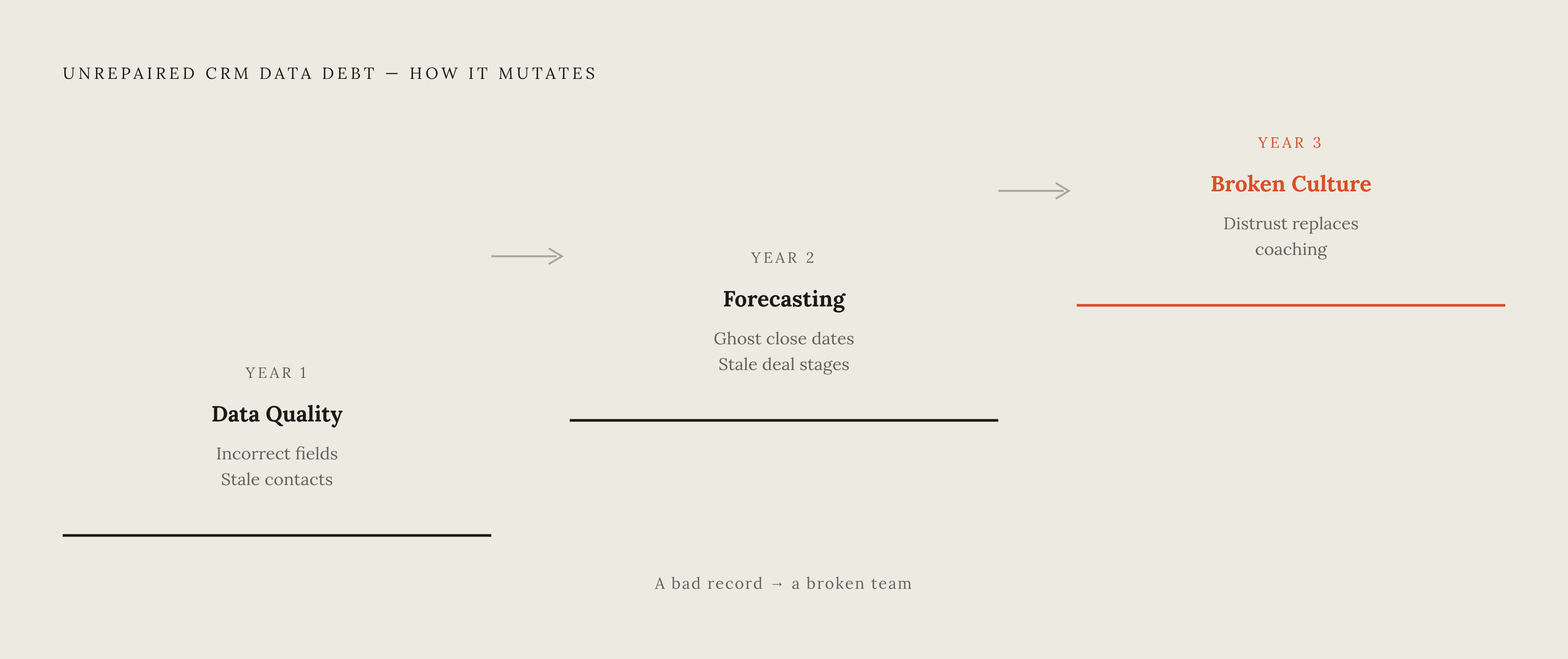
The year-by-year progression is a useful diagnostic frame. At year one, the ledger looks like a data quality problem. At year two, it looks like a forecasting problem, as outdated deal stages and fictional close dates undermine pipeline reviews. By year three, the same debt can look like a sales culture problem because incomplete logging and distrust have become part of how people work.
Instead of discussing how to win, managers interrogate reps about what the CRM should say. Correcting a close date can repair the current record, but it cannot retroactively correct decisions made from earlier reports. Fixing a field does not bring trust back right away, either. The longer debt remains unpaid, the more its repair involves both records and the working habits built around them.
Why AI in the revenue stack raises the stakes on unrepaired data
AI removes a pause that previously limited this damage. When a person had to work with each record before acting on it, bad data often slowed work down. An agent can act on the same data at machine speed, without waiting for someone to notice that it is wrong. The error becomes an instruction to act on. A list containing duplicates and departed contacts can cause an agent to email all of them, update the wrong records, and log activity against accounts that no longer exist.
Those actions can then contaminate the evidence used by other systems. Lead-scoring models that learn from split or stale activity data pick up the wrong engagement patterns and route similar accounts to the wrong rep tier. Poor CRM data has caused inaccurate AI results for 71.4% of marketers. The model uses the database’s errors to make decisions, which can lead to more activity records that mislead.
The consequences extend beyond outreach and routing when executives use AI-generated outputs for hiring, budget, and market decisions. A dirty CRM can sit several steps behind advice that seems to make sense, so the error it began with can be hard to spot by the time it reaches a board deck. The risk has therefore changed in speed and reach. The same debt that once delayed a rep can now shape many actions before a human reviews the underlying records.
What manual and periodic cleanup actually accomplish on the debt ledger
Manual and periodic cleanup have real value because they reduce the outstanding balance of errors. Correcting stale fields and removing duplicates improves the database at that point in time. Entry validation also prevents some new mistakes. Mandatory fields and rule-based checks establish useful boundaries, but a structurally valid record can still be factually wrong. Those controls leave historical debt in place and miss some errors that pass validation.
Reps manually log only 30–50% of their sales activity, so a cleanup can operate on an incomplete picture even when the reviewer is thorough. If the reviewer does not know a call happened, the absence can pass unnoticed. Relying on reps to re-enter corrected data also preserves manual entry and low adoption as sources of future defects.
Periodic cleanup thus pays down principal but may leave the effective interest rate unchanged. Where the underlying cause remains unchanged, the database can return to its earlier condition within three to six months. The cleanup reduced current errors, but the interval before the next cleanup still gives remaining and newly introduced errors time to propagate. That distinction establishes the proper comparison with continuous repair, which must change the rate of damage.
How continuous automatic repair keeps CRM data clean and accurate over time
Continuous automatic repair changes the ledger by shortening the interval between an error appearing and its correction. That interval is the opportunity for compounding. When repair reduces it from months to hours or minutes, an incorrect record has less time to produce bad signals and corrupt downstream records. In the financial analogy, the intervention reduces the effective interest rate as well as paying down principal.
In month one, errors caught before they generate downstream records reduce both the existing balance and the creation of new debt. By month three, pipeline reports can be built on fewer errors inherited from earlier activity. By month six, models trained on CRM outputs can inherit a cleaner signal. These are possible linked stages of propagation.
Continuous native hygiene and periodic external batch cleaning each have a role in this setup. Native repair fixes errors as they arise, while batch cleaning takes care of backfills and legacy data. The latter does not become unnecessary simply because continuous repair exists. Instead, the two approaches address different parts of the ledger. Over a second year, the gap between continuous repair and periodic cleanup can widen through compounding because each repaired record has had fewer opportunities to corrupt subsequent records and decisions.
Where the compounding-reversal effect shows up first in a revenue operation
In the first weeks, the most immediate gains appear near the point where records trigger action. Cleaner contact data supports deliverability, while fewer duplicates and stale records reduce the opportunities for outreach to target the wrong person. Routing can improve early for the same reason. These effects arrive before broad forecast trust recovers because they depend more directly on the records being repaired. They are the earliest signs that fewer errors are entering the next stage of the funnel.
Over subsequent months, lead scoring and routing benefit from a more consistent activity history and opportunity records that reflect actual deal stages. Fewer misleading inputs shape which accounts get priority and who gets assigned to them. Pipeline reports then start to show those cleaner inputs. The repair has moved from improving individual actions to improving the evidence used to coordinate revenue work.
Over the quarters that follow, trust in forecasts can start to bring people back to using the CRM. Reps who believe the pipeline report reflects reality have more reason to maintain the system, and more logged activity gives future records a better starting point. That feedback improves the next forecast further. AI model reliability has a longer lag because it depends on progressively cleaner data reaching training and subsequent outputs.
The strongest objection is that automatic repair treats symptoms while broken processes regenerate the debt
Inconsistent processes, unclear field ownership, and undocumented expectations can produce dirty data faster than an automated system can clean it. Repair alone does not resolve those causes. A system that repeatedly corrects the same defects while workflows recreate them remains a cleanup treadmill. It may limit some damage now without keeping debt on a downward path.
The answer requires governance as part of the repair infrastructure. Data contracts, confidence thresholds, audit trails, and rollback capabilities give automated correction boundaries and accountability. Clear governance and intelligent business rules also support user acceptance, which is necessary if the CRM is to remain maintained. For agents acting on records, approval-based autonomy adds a specific control. Someone must be able to see what an agent plans to do and stop it.
This changes what counts as a successful repair system. Speed alone is an inadequate measure if corrections cannot be governed or if broken processes immediately recreate the error. The aim is for well-built workflows to keep data clean automatically, with repair fixing the errors that still arise. Repair and process reform address different parts of the same equation. Together, they can reduce both the time an error has to spread and the rate at which new errors enter the CRM.
What the debt ledger looks like after a year of governed continuous repair
After a year, the meaningful change is not simply a lower count of incorrect records. With governed continuous repair, the outstanding balance can fall, new debt can build up more slowly, and fewer errors can pass to downstream systems. The ledger has changed direction. Forecasts and AI outputs are no longer drawing repeatedly on the same accumulation of unresolved defects. The revenue operation has a stronger basis for decisions because repair has been working throughout the period in which those decisions developed.
Forecast trust is among the last gains to consolidate because both leadership and reps must believe the pipeline report reflects reality. When that confidence returns, the CRM can move from a disputed system of record toward a shared system of truth. Reliable records also provide a prerequisite for agents to act autonomously within governed limits. That does not imply complete automation. Complex CRM data enrichment still requires a hybrid model in 2026, with automated repair for scale and human validation for edge cases and accountability.
The forward-looking consequence is that waiting has a cost independent of the eventual cleanup’s thoroughness. A later project can correct records, but it cannot recover the intervening months in which errors shaped outreach, forecasts, and decisions. Starting governed repair earlier changes what the database produces in those months. The debt ledger is a clock, and automatic repair changes what it is counting.