The Deduplication Decision Framework Your Data Steward Actually Needs Before Touching a Contact Record
Define your merge rules before your steward touches a single contact record.
CRM hygiene is the continuous work of keeping CRM records accurate, consistent, and free of duplicates without losing their history. The safest way to remove duplicate contacts is to normalize records, set match confidence, decide which field values to keep, and resolve parent accounts before merging. A steward needs those rules before touching a record, and keeping records accurate over time means using the same logic at ingestion.
Why duplicates are the symptom and a bad merge is the disease
A steward finds two records for the same person, selects the wrong surviving record, and merges them. The deal history disappears from where the team expects it. What looked like routine cleanup has become a trust problem. Duplicates split contact history and create double outreach, but an unsafe merge can permanently delete a record and orphan deals, activities, and notes. The visible duplicate was inconvenient. The attempted repair can be irreversible.
Salesforce’s help states that merging contacts is irreversible. HubSpot’s documentation likewise states that merges are irreversible, making safety the starting criterion for deduplication. Duplicates are easy to see and embarrassing, while the risks of a merge often stay hidden until it is done. A drop in the duplicate count alone thus does not show that the CRM data is better.
Contact data also decays, continually generating ambiguous records as details change. This is a structural problem. Because ambiguity returns, a one-time cleanup cannot settle it. The framework must make each merge defensible as it shortens the duplicate queue.
What a steward is actually deciding when they look at two contact records
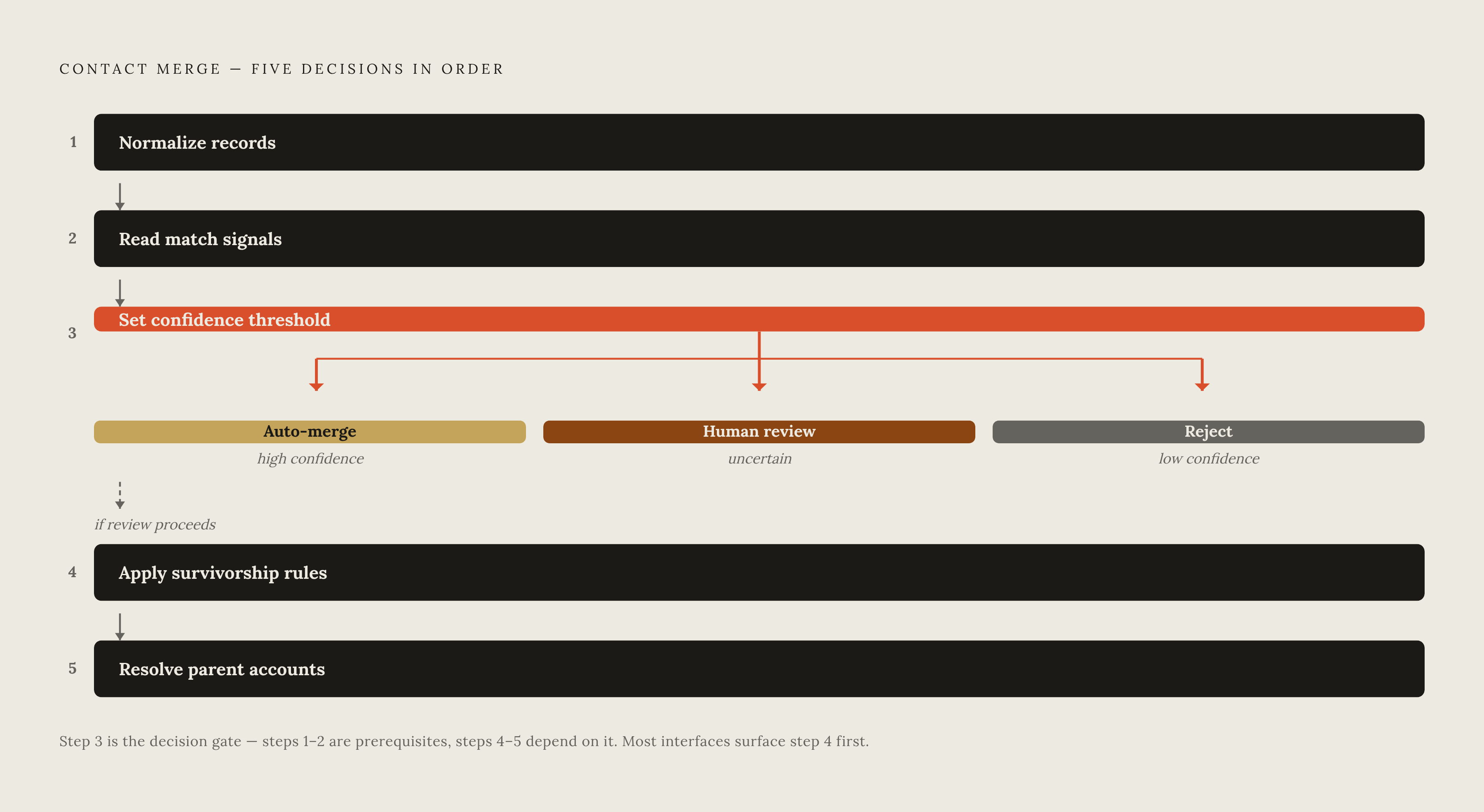
A merge contains five decisions. The steward first checks the records’ normalization for fair comparison, then their field-level signals for evidence of the same person. Next comes the confidence decision, which routes the pair to automation, review, or rejection. Only then does the steward decide which field values survive and whether the parent account is resolved before execution.
The interface can hide that order by showing a merge button before it shows the reasoning. Choosing which value to keep feels like the main task. In fact, that is the fourth decision, dependent on three earlier ones. ZoomInfo’s CRM hygiene framework places governance rule definition before technical deduplication, making the logic a prerequisite for execution.
Normalizing records before any comparison begins
Two records that really are duplicates can fall below a fuzzy-match threshold just because their fields use different formats. The result looks deceptively clean. A pair that should have been reviewed never enters the queue, so the absence of a match conceals a false negative. To avoid that failure, the steward’s first checkpoint is whether the comparison inputs have been standardized.
The normalization pass trims whitespace and lowercases string fields. It expands abbreviations such as “Inc.” to “Incorporated” and “St.” to “Street,” formats phone numbers to E.164, and lowercases and domain-validates email addresses. Company names also need to have their legal suffixes removed before fuzzy comparison. These operations prepare the evidence. They do not establish identity. Their purpose is to keep formatting differences from masquerading as differences between people or companies.
ZoomInfo’s data quality guide describes how “IBM,” “International Business Machines,” and “IBM Corp.” can persist as separate records when inconsistent naming defeats uniqueness checks. Standardization therefore belongs before enrichment as well as matching. Otherwise, enrichment wastes API calls and embeds inconsistency in appended fields. The practical test is straightforward. If known duplicates are missed because of their raw formatting, the team needs to address the missing normalization pass before it works on the matching algorithm.
Reading field-level match signals in priority order
A verified email match has the highest weight. After lowercasing, normalized exact agreement is sufficient identity evidence on its own, although it does not waive the remaining merge checks. An exact LinkedIn URL match follows as a near-conclusive signal because the identifier is globally unique. A normalized phone match also deserves high weight, but shared lines and VOIP numbers prevent it from being conclusive alone.
Name and company, taken together, give a fuzzy signal with a medium weight. Neither field is sufficient by itself. Name alone has the lowest weight because it gives too many false positives to be grounds for a merge. A steward comparing two matching names must therefore distinguish recognition from identification.
Algorithm choice follows the field being compared. Jaro-Winkler suits personal names because it rewards prefix agreement and handles “Jon” and “Jonathan” better than edit-distance matching. Levenshtein suits character-level typos in short identifiers and account numbers, while phonetic codes such as Soundex and Metaphone help with spelling variants such as “Smith” and “Smyth.” Email and phone require normalized exact comparison, since fuzzy matching introduces false positives. Before approval, the steward should be able to identify the matching fields, the algorithm, and the score rather than simply report that the system flagged the pair.
Setting confidence thresholds that determine who touches the record
Without explicit boundaries, different stewards can interpret the same score as permission to merge, a reason to investigate, or grounds for rejection. The 0.80–0.95 band requires review by a named steward with merge rights. The 0.60–0.80 band needs a closer look and may need a second approver or data team lead. Governance must also define the boundaries for automatic action and rejection.
Those boundaries require calibration against the actual dataset. A database built from a single web form has less noise than one assembled from list imports across three years. The same score does not mean the same thing in both. Before enabling auto-merge, the team should validate its matching logic on a sampled batch. Automation otherwise amplifies weak identity resolution faster than people can correct it.
Pressure to automate more in 2026 makes the order of these controls more important. AI proposes a match with evidence, deterministic rules validate the confidence tier, and a human approves proposals below the defined automation threshold. Autonomous writes are allowed only in tiers with clear rules for their use. This separates the system’s ability to suggest a merge from its authority to execute one.
Applying survivorship rules at the field level, not the record level
The surviving contact should be assembled. Choosing one winning record and retaining all its fields can discard better information from every other source. Identity matching checks whether the records describe the same person. Survivorship decides which values to keep. Those are separate judgments. Even with a strong match, a poor rule can choose an outdated phone number or an unverified email.
Consider a merge screen with records A, B, and C. The verified email can come from record A, while the most-recent phone comes from record B. Job title can follow the latest timestamp, and company name can follow source priority, such as an account executive’s CRM entry over a web-form self-report. The fullest company profile can come from record C.
Different fields therefore need different rule types. Most-complete prefers a populated field over a null value, while quality-scored prefers a value verified or enriched from a trusted source. A conditional rule might keep the CRM-entered email unless it has bounced, then use the enriched alternative. A hybrid chain can apply source priority first, recency second, and completeness as a fallback. These rules must be documented before execution. A steward unable to explain the rule for a key field should pause until the rule is explained.
Merging parent accounts before child contacts
Parent accounts must be resolved before contact merges run. In most major CRMs, related deals, activities, and notes typically reattach to the surviving master, but transfer behavior and exceptions vary by platform. Merging or deleting a contact before its account is resolved can leave those records attached to the wrong parent or detached from a valid one.
The execution sequence begins with duplicate accounts, applying matching, confidence, and survivorship rules at that level. Once the correct parent exists, the contacts can be resolved. Before either operation proceeds at scale, the steward needs a full export of affected records and a small test batch. That test must verify field survivorship and related-record reattachment. Deal, activity, and note counts on losing records must agree with what will transfer to the master.
Salesforce and Zoho cap manual merges at three records at a time, while HubSpot’s native manual merge is limited to two. Zoho lacks native fuzzy matching, and Salesforce lacks native auto-merge. These are execution constraints within which the framework must still apply. A steward must plan the work around what the platform can compare and merge without confusing native capability with sufficient evidence.
Who owns the decision and when the framework governs them
Confidence tiers become enforceable only when named roles own them. The data steward is accountable for quality metrics and cleanup cadence and can act on high-confidence matches after completing the pre-merge checks. Admins or designated power users have bulk merge rights and run merges that exceed a set record threshold. A second approver, such as a data team lead or RevOps manager, is required for the 0.60–0.80 band and bulk operations affecting accounts. Individual sales reps should flag suspected duplicates for an authorized person to merge.
Accountability must cover automated proposals as well as human actions. RevOps governs the evidence AI submits, the deterministic rules that validate it, and the approval boundary before a write. Where autonomous correction is authorized, that permission must be explicit. Otherwise, a system can bypass the same restrictions that constrain a steward. Limiting bulk delete and using archive or exclude functions where possible also limits who or what can make changes that destroy data.
The framework also needs shared business definitions. ZoomInfo’s framework grounds governance in documented meanings for TAM, ICP, and the characteristics of a duplicate before software applies rules at scale. Without those definitions, a lower duplicate rate can hide rushed merges and a loss of trust. Operating rhythm makes the policy usable. Documented merge rights, a data dictionary the team actually reads, and monthly review meetings keep governance present between cleanup cycles, which are typically quarterly for most teams and monthly for larger or fast-moving databases.
Why the framework fails without a continuous prevention layer upstream
Merge-time controls address the backlog. New duplicates come through web forms that skip detection, imports with no deduplication pass, and migrations that fail to match records already there. Integration syncs add ambiguity when connected systems resolve identity separately. Manual entry contributes when a rep creates a record after an unsuccessful search without further investigation. A steward can process the queue correctly while these entry points keep replenishing it.
The cheapest correction is at the point of entry. Validation rules, enforced field formatting, and duplicate detection at form submission prevent accumulation and the subsequent cleanup work. The same comparison logic must also govern imports, migrations, and syncs. ZoomInfo’s guide describes the trust collapse that follows persistent dirty data, when reps stop believing the CRM and stop updating it. Managers then compensate with manual overrides, further weakening the system’s role in the sales process.
With 45% of organizations reporting that their CRM data is not ready for AI, trustworthy automation also depends on upstream controls. A duplicate introduced at submission can propagate into high-velocity errors beyond the reach of a later human review cycle. Agentic data reliability tools address that gap by continuously monitoring creation, proposing evidence-based fixes, and applying corrections within governed confidence tiers. People spend more time on exceptions and less on triage that keeps coming back. The framework supplies the steward’s decision logic today. The scalable system applies it continuously at ingestion, before a quarterly cleanup discovers damage already done.