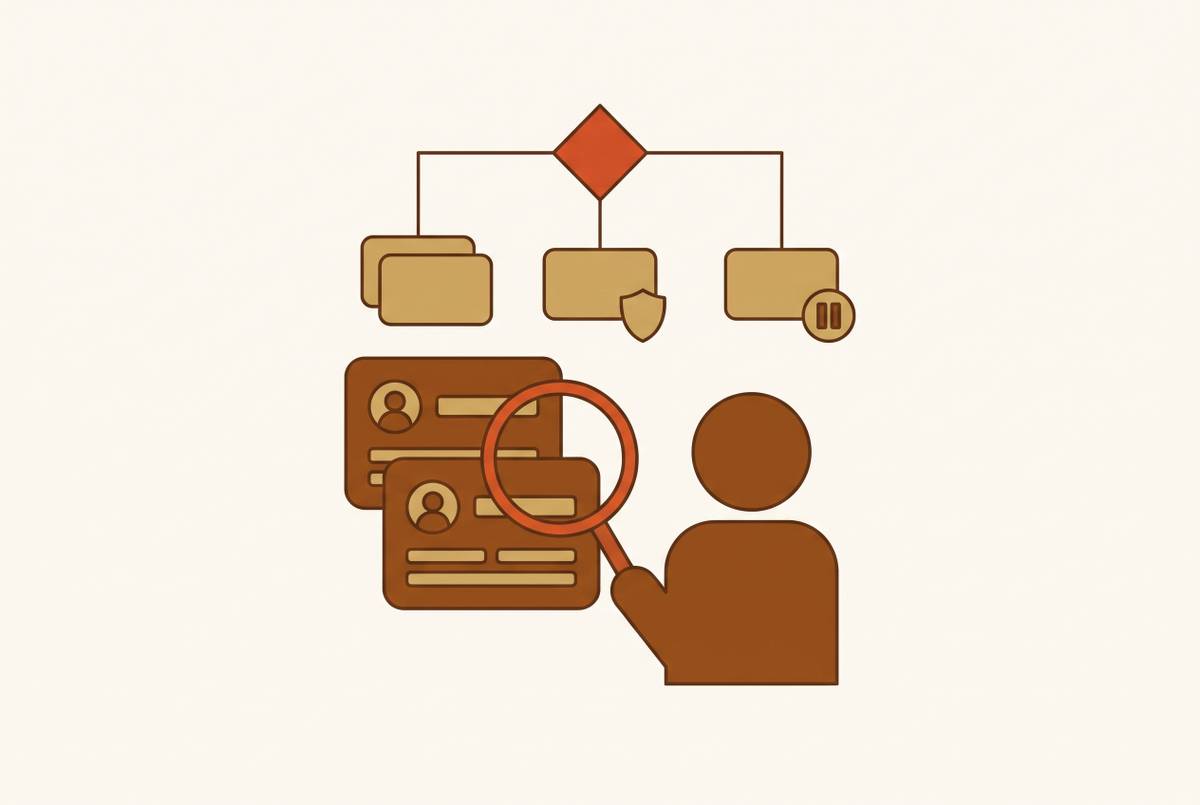
When Your CRM Is Drowning in Duplicates and Broken Hierarchies Start Here
Fix duplicate records and broken links before they corrupt your pipeline and reporting.
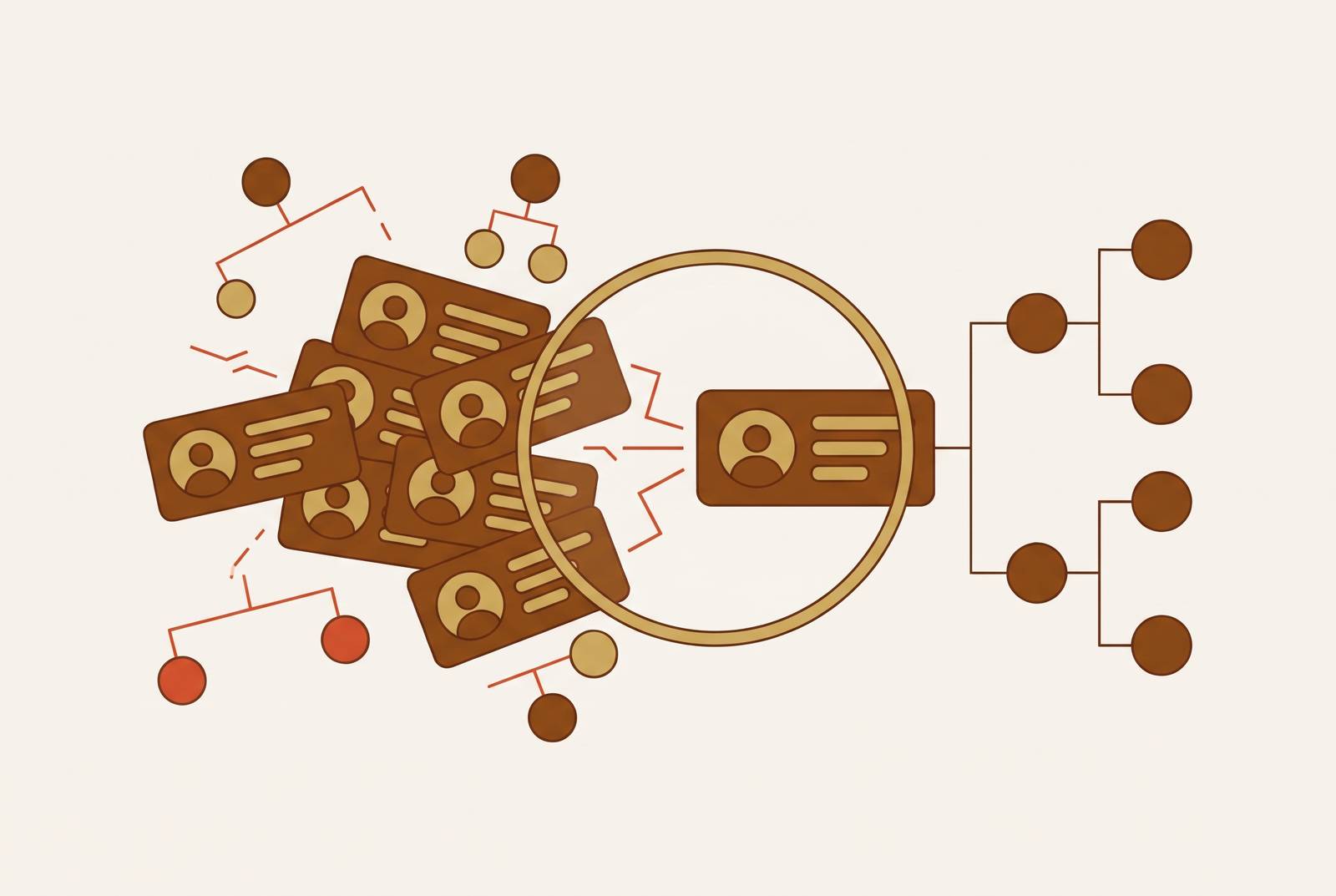
CRM hygiene is the ongoing work of keeping CRM records correct, free of duplicates, linked as they should be, and ready to use. Recovery starts by separating two problems: duplicate identities and broken account relationships. Resolve duplicates first, rebuild hierarchies second, and govern both continuously so that cleanup becomes lasting reliability.
Why CRM chaos splits into two distinct layers that need to be fixed in order
In the first layer, several records describe the same contact or account under different names, email formats, or identifiers. SellWizr describes “Acme Holdings Inc.”, “Acme Holdings”, and “ACME Holdings, Inc.” as examples of entity-level dirt. These are candidates for consolidation.
Structural errors require a different kind of judgment. A holding company and its subsidiaries may all be legitimate accounts, yet lack the parent-child links that make their relationship visible. Merging them would erase distinctions the CRM needs, while linking duplicate parent records would embed redundant identities into the structure. Identity therefore has to be resolved before relationships.
How duplicates get into the CRM and why they compound without intervention
Duplicates are the predictable output of uncontrolled entry points. RevBlack’s audits identify reps creating records without searching first as a recurring source. Forms can create a new contact each time someone submits them, while marketing, event, and purchased lists add records without pre-import deduplication. Integration syncs are another way duplicates get in because they can use different rules for formatting and null-handling logic. Migrations then move existing duplicates into a new system’s associations and activity histories.
Exact matching cannot reliably reconcile all these variations. Name abbreviations, legal-name aliases, and cross-system identifiers can describe the same entity without sharing an identical string. Stale records make the comparison harder because email addresses, phone numbers, and company names no longer provide dependable identity evidence. RevBlack also identifies undocumented admin turnover as an accelerant. When knowledge of workflows and field ownership leaves with an operator, the next admin builds around the existing inconsistencies.
Connected marketing systems can send conflicting emails, attribution can break, and pipeline reports can inflate. AI agents acting on the wrong record can repeat the error at machine speed. This makes accumulation more than a storage problem, even before its financial effects are measured.
How to audit your duplicate situation before touching a single record
To begin remediation, establish a baseline before authorizing merges. Measure the duplicate rate by object and identify where candidates concentrate, distinguishing safe matches from cases that need human judgment. Use fuzzy matching to find variants such as “John Smith”, “J. Smith”, and “Jon Smith”. Exact-match-only audits will miss these candidates and understate the work. Native CRM checks can address exact matches, but purpose-built matching is needed for a meaningful assessment of less obvious duplicates.
Next, map every paid app that reads or writes CRM data and record which fields it touches. Conflicting write rules identify ongoing sources of duplication. Assess license and tier exposure as well, because inflated record counts can push the organization into a higher CRM pricing tier. Estimate what the errors cost through the workflows and reports they affect. This connects the technical baseline to the case for resources.
To prioritize by record value, Balances Cloud recommends focusing on active accounts, high-AR customers, and active leads, while archiving cold records older than the business retention window. The finished audit should show duplicate rates, integration touch-points, which risks come first, and an estimate of downstream cost. That output distinguishes targeted remediation from a cleanup sprint that recurs every six months.
Merging duplicates without destroying the data you need
The safest way to remove duplicate contacts is to combine explicit master-record rules, confidence-based review, and a reversible merge log. Begin with completeness, recency, and authority, rather than choosing whichever record was edited last. Recency counts when the update came from a verified source. Authority determines which system should govern each field, such as preferring a phone number from a verified enrichment source over one manually entered by a rep. SellWizr frames this decision around identifying authoritative sources and updates that are safe to activate.
AI assistance can shorten the comparison process. Inogic’s DeDupeD for Microsoft Dynamics 365 describes AI-enabled master record selection with a confidence score and plain-language reasoning. Comparing duplicate account records with 40+ fields by hand takes many minutes per merge job, while the AI analysis described takes seconds. The product stores AI decisions in an audit trail. Human review still governs the final judgment.
Stage execution by confidence: automate high-confidence matches supported by identical email, company, and phone information, route medium-confidence candidates to a steward queue, and investigate low-confidence cases manually. Archive records outside the retention window separately, keeping stale values out of active masters. Every automated or human merge needs a reversible log because a mistaken merge can destroy activity history, attribution, and relationship context.
Why prevention at the entry point changes the economics of deduplication permanently
A completed merge pass does not stop new duplicates. Without capture controls, the duplicate rate heads back toward baseline within months and the organization pays to do the work again. Prevention changes that pattern by checking records before they spread into connected systems. Balances Cloud recommends embedding dedupe checks in forms, integrations, and APIs. Capture controls should also block bad imports, enforce unique keys such as contact email and account domain, and require owner assignment when records are created.
Integration governance then defines which system owns each field so that syncs update existing records. A monthly digest should surface potential duplicates and anomalies to data stewards. Event-driven checks reduce the gap further by assessing records when they are created or updated. Scheduled batch scripts leave time for duplicates to accumulate and propagate between runs. The timing difference changes how much downstream repair is needed.
Agentic monitoring can further cut the time between finding a duplicate and fixing it. An agent that proposes or applies merges continuously differs from a tool that only produces a weekly report, although its decisions still need the merge safeguards already established. This gives hierarchy work a stable record set. Without entry-point prevention, newly created duplicate identities can undermine relationships even as they are being rebuilt.
What hierarchy failure actually looks like and why dedupe tools cannot fix it
A duplicate-free CRM can still hide its account relationships. SellWizr’s analysis of financial services describes holding companies whose subsidiaries, funds, SPVs, and trusts have accounts with no links between them. It also describes an institutional allocator, its investment committee, its OCIO, and its gatekeeping consultant sitting as unlinked records. An asset manager then cannot see that an open manager search and an existing mandate belong to the same relationship. None of those records has to be a duplicate for the account view to fail.
The same pattern occurs in complex B2B account structures. In B2B SaaS, an acquired subsidiary may remain separate from its parent, hiding product usage, expansion opportunities, and renewal risk from the parent account owner. Unlinked relationships can also produce double coverage, with two relationship managers pursuing what appears to be separate opportunities but is actually one. These are coverage and attribution failures.
Deduplication identifies records that describe the same entity. Hierarchy resolution determines how distinct entities are connected. String similarity cannot establish legal ownership, and a standard dedupe tool has no basis for inferring that a fund belongs within a particular holding-company structure. That takes registry data, entity-resolution logic that understands legal structures, and human review when the relationships are still unclear.
How to identify and prioritize which hierarchy relationships are worth rebuilding
To set the scope of hierarchy repair, start with missing links that affect revenue decisions being made now. Look for accounts with significant deal history that share a domain, address, or key contact but have no parent-child relationship. These similarities signal possible ownership relationships. Also examine open opportunities owned by different reps that resolve to the same ultimate buying entity. Renewal or expansion records that a subsidiary’s parent account owner cannot see are another signal.
Order the resulting queue by how much revenue is at risk. Tier one consists of accounts in active pipeline or with open renewals, where broken relationships affect immediate forecasting and revenue decisions. Tier two covers accounts in the top revenue decile by ARR, where coverage gaps and missed cross-sell are most expensive. Remaining accounts belong in tier three and can be addressed through ongoing monitoring.
CRM evidence alone cannot establish a legal subsidiary relationship. External company registries and ownership databases are needed to confirm ownership before the structure changes. Joint ventures, partial ownership stakes, and complex fund structures require human review when the evidence is ambiguous. Automated resolution needs a confidence threshold and an escalation path. The diagnostic output should therefore distinguish prioritized relationships from relationships that are ready to activate.
Rebuilding account hierarchies without breaking the reporting that depends on them
Hierarchy repair changes the behavior of a live CRM. A parent-child link can immediately affect reports, territory assignments, rollup calculations, and automation. To control that impact, stage changes in dependency order, confirming that the parent is clean and correctly identified before linking children. Otherwise, errors in the parent become embedded in every linked account. Begin with tier-one relationships rather than changing the entire account structure at once.
Validation must test associations. Even when record totals match, owners, stages, and consent flags may have changed. Spot-check newly linked parent-child pairs to see whether subsidiary pipeline rolls up correctly, territory assignments match the structure, and forecasts change as expected. Validate that reporting impact before proceeding to tier two. A single misconfigured link on a large account can distort a territory’s pipeline view.
SellWizr distinguishes signal-level dirt, including stale last-touched dates and pipeline stages, from lineage-level dirt, where the record lacks a defensible source trail. Address these defects during hierarchy repair because a correct parent link neither refreshes a stage nor establishes provenance. Validated relationships supported by current signals and traceable records provide the foundation for reliable rollup reporting, cross-sell visibility, and AI-driven account intelligence.
How do you keep CRM data clean and accurate over time?
Lasting CRM hygiene requires a permanent operating discipline. RevBlack identifies five recurring audit patterns, including undocumented admin turnover, duplicates from multiple entry points, lifecycle stage mismanagement, absent governance, and migration residue compounded by integration drift. These causes continue after remediation ends. Every new integration, rep, or campaign can give inconsistent data another way in. Governance must cover new touch-points as well as those that were in place during cleanup.
Assign named stewards to each CRM object, with documented standards for entry, maintenance, and retirement. Check at least monthly for duplicate candidates, signs of broken hierarchies, and field decay. Make the output an actionable queue. Track completeness, accuracy, and decay rate as standard monthly metrics with pipeline. These responsibilities distinguish a data reliability program from a project whose ownership ends after the final merge.
Continuous automation can make that discipline sustainable at scale. An AI agent can monitor duplicate signals, hierarchy anomalies, and field decay, then propose or apply fixes within the established confidence thresholds and review paths. It does not replace governance. SellWizr describes this shift as a layer that keeps working to resolve records, manage hierarchies, create trusted golden records, and send cleaner context back to the systems already in use. Because connected systems propagate errors continuously, CRM hygiene needs an operating model that can respond on the same basis.