Cost of a Data Incident in a Cloud Data Warehouse
Detection delays cost nearly $2 million more than early identification of cloud warehouse breaches.

A cloud data warehouse incident does not end when the alert fires. It ends, if it ends at all, months later, after forensics, legal review, customer churn, and a slow bleed of trust that most budgets never account for. The price tag has almost nothing to do with the technical fix and almost everything to do with how long the problem sat undetected and how much damage it did while it waited. That is the argument this piece makes, and the numbers below back it up: organizations that treat data quality as a lesser cousin of security are budgeting for the wrong incident.
Some 94% of enterprises now run workloads in the cloud, and the warehouse has become the default home for the data that runs a business: sales records, patient files, transaction logs. That shift breeds a habit that does not survive scrutiny: treating uptime and durability as a stand-in for data reliability. They are not the same thing, and confusing them is the single most expensive assumption an organization can make about its own infrastructure. A warehouse can hit every availability target its provider promises and still serve up numbers that are wrong, stale, duplicated, or quietly missing a chunk of the table nobody flagged. Cloud infrastructure guarantees that the system stays up. It says nothing about whether the content inside it is correct, current, or logically sound, and that gap is where incident costs pile up.
Split the problem in two, because the two halves get budgeted, or ignored, very differently. Security breaches, unauthorized access, exfiltration, ransomware, are the category most finance and security teams already plan for. Data quality incidents, silent corruption, broken pipelines, records that go stale without anyone noticing, are the category almost nobody line-items, even though the financial damage runs just as deep. Treating the second category as a lesser problem is the mistake that costs just as much and needs correcting first, before any technical fix.
Cloud-specific factors that push breach costs above the global average
Storage location changes the bill directly, and the direction of that change surprises people who assume cloud is inherently safer than on-prem. Breaches involving data spread across on-premises, private-cloud, and public-cloud environments averaged $5.39 million, the highest of any storage category IBM tracks. Public-cloud breaches alone averaged $5.38 million, against $4.56 million for breaches confined to on-premises systems. Spreading data across environments carries a real, recurring premium, not a one-time fluke.
The reason cloud costs more to clean up starts with the entry point, and it is not what most people assume. DataStackHub data put misconfiguration at 19% of total breaches in 2025, and that number does not indict the cloud platform. It indicts the people running it. Most cloud breaches trace back to mismanaged settings, loose access policies, and plain human error, not flaws in the underlying infrastructure. The exploitable surface is organizational: who has access to what, and whether anyone checked lately.
Scattered data compounds the problem. Thirty percent of 2025 breaches involved information spread across multiple environments, and every additional environment adds its own containment perimeter and its own delay before anyone realizes what has been touched.
Geography sharpens the exposure further. IBM's 2025 report put a large national market's average breach cost at $10.22 million, the highest of any country measured. The 2026 report pushed that record to $11.5 million, an 11% jump driven by tougher regulatory penalties and rising business costs. A company running a cloud warehouse inside that market starts from the steepest baseline risk in the world before a single technical detail even enters the picture.
The detection lag problem: why time is the biggest cost multiplier
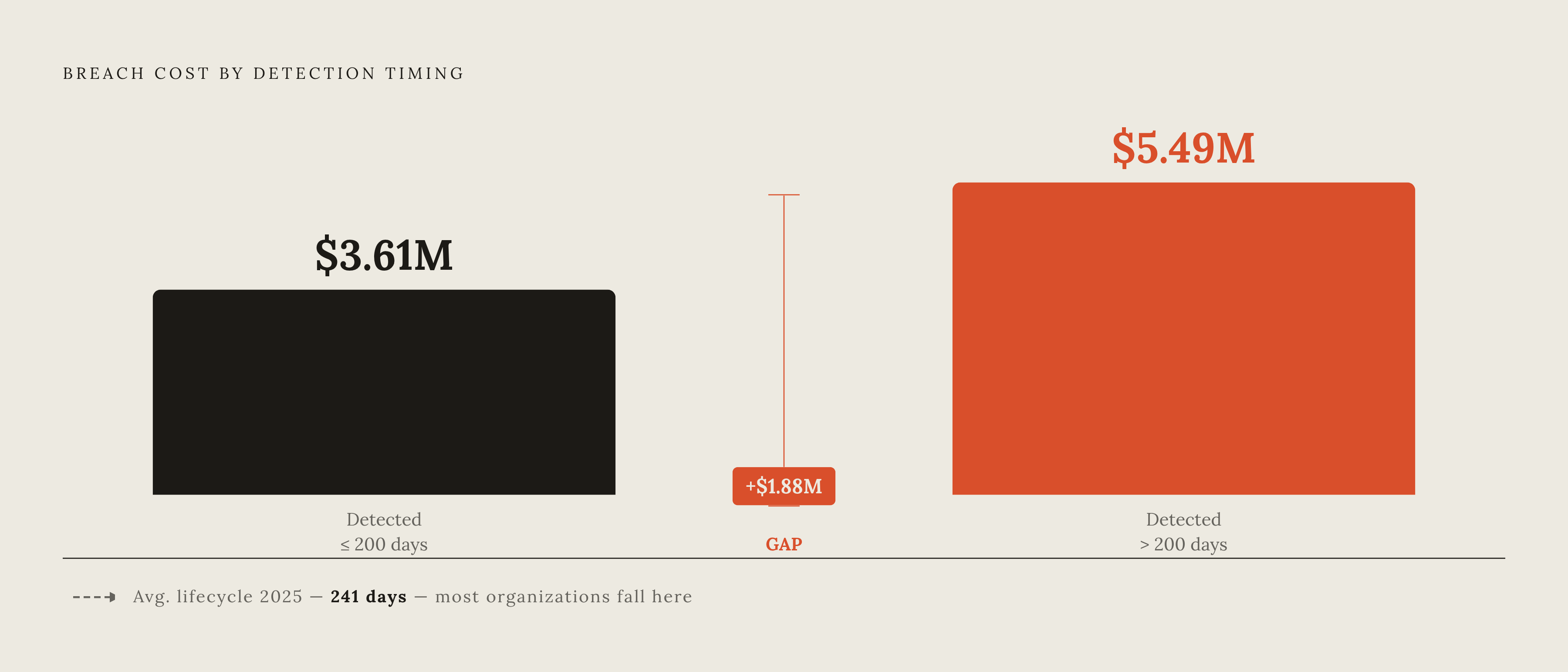
Breaches identified after 200 days cost an average of $5.49 million, versus $3.61 million for breaches caught before the 200-day mark. That swing, nearly $2 million, has nothing to do with how sophisticated the attack was. It comes down to how fast the organization noticed, full stop.
The average breach lifecycle, identification plus containment, ran roughly 241 days in 2025. Most organizations are already living on the expensive side of that split before they know they have been hit. Stolen credentials, one of the most common ways into a cloud warehouse, took about 292 days to resolve on average in IBM's 2024 report, the slowest of any attack category measured. That is 51 days past the mean, and every one of those extra days is time for damage to compound quietly in the background.
Cloud warehouses are especially bad at surfacing this kind of failure early, because data quality problems rarely announce themselves at the point of failure. A pipeline feeding a healthcare ML model can feed it incomplete patient records for over three weeks straight, with predictions drifting 30% off target before anyone catches it. Nothing crashes. No alert fires. The failure sits there, feeding bad inputs downstream, invisible until someone checks the output against reality.
That is the pattern with data quality problems generally. Duplicated records or other errors produce dashboards that do not match reality, AI systems making calls that do not make sense, or reconciliation reports that will not tie out, and none of it becomes visible until the data gets checked against actual outcomes. Duplicated records can inflate a sales dashboard for weeks while everything looks clean on the surface, and the problem becomes visible during quarterly reconciliation. By then, trust in the entire reporting stack has already taken the hit, retroactively, for every number anyone relied on in the meantime.
Direct remediation costs: what organizations pay to clean up an incident
Remediation is a stack of bills, and each layer charges separately.
Forensics comes first: figuring out what data was touched and how the intrusion or failure happened. Notification follows on a legal clock in most jurisdictions, so the organization pays for speed even if it is not ready to notify. Legal and regulatory response work sits on top of that: outside counsel, regulatory filings, the paperwork trail a breach demands. Then comes the technical cleanup itself: patching the hole, rebuilding access controls, restoring data to a known-good state.
Ransomware carries its own math, and it argues against paying. Sophos' State of Ransomware 2025 report put the average ransom payment at roughly $1.0 million (median), but recovery and restoration costs ran separately at around $1.53 million on average. Paying the ransom is often the cheaper half of the ordeal. Downtime and rebuild costs routinely outweigh the ransom itself, which makes the payment decision almost beside the point, and organizations that fixate on the ransom figure are budgeting for the wrong number.
Zooming out clarifies the shape of the total bill. Detection and escalation costs, combined with lost-business costs, make up 63% of the global average breach cost. The technical fix is a minority expense. Most of the money goes toward the time it took to notice the problem and the business damage that piled up while it went unnoticed.
Per-record costs scale these estimates to an actual warehouse. IBM's 2023 figure put the average cost per compromised record at $165; by the 2026 report, customer PII specifically averaged $192 per record. Multiplying that against the record count in a given table makes the exposure become concrete fast. Finance teams should be running that multiplication before an incident, not after.
Shadow AI deserves its own line item now. IBM's research found that unauthorized AI use added $670,000 to breach costs, and breaches tied to AI systems almost universally involved a lack of proper access controls. Three years ago, this cost category did not exist in most remediation budgets. Now it does, and it is growing.
The regulatory and legal exposure layer that most cost models undercount
Regulatory pressure on cloud data keeps stacking. SEC disclosure rules, state-level breach-notification laws, a major overseas data protection regulation, HIPAA for health data, and sector-specific enforcement all impose mandatory response obligations, each with its own financial teeth. GDPR fines alone have run into the hundreds of millions in recent years, and EU organizations face mandatory disclosure obligations on top of those penalties, adding further response costs to the base cost of the breach.
Cloud warehouses create a specific flavor of this exposure. Data stored across multiple cloud regions can trigger several regulatory regimes at once, simply because of where the bytes physically sit. Most organizations do not have a complete map of what regulated data, PHI, PII, financial records, actually lives where inside the warehouse, and that gap is the real liability. Finding it out during a breach, under a notification deadline, costs far more than knowing it in advance.
Misconfiguration-driven breaches carry a particular legal sting here. The 19% of 2025 breaches tied to misconfiguration is expensive to defend precisely because misconfiguration reads to a regulator as a governance failure, not bad luck and not a sophisticated attacker. It is evidence the organization did not have its own house in order, and regulators treat it that way.
Healthcare and financial services feel this most acutely, averaging $6.64 million and $6.29 million per breach respectively. Both sectors carry regulatory penalty structures baked directly into the breach cost calculation, not layered on as an afterthought.
Lost business, customer trust, and the revenue damage that outlasts the incident
Lost business already sits inside IBM's headline number, folded into that 63% figure alongside detection and escalation costs. Internal post-mortems rarely try to measure it on its own, so most organizations never see the actual shape of what they lost.
Breaking it down reveals a few distinct wounds. Existing customers churn or scale back spend once an incident goes public. Prospects mid-pipeline walk away during or after disclosure. Revenue stops flowing outright while systems are offline or under investigation, since transactions and operations cannot proceed. A longer tail runs through the aftermath: an extended stretch where customers, partners, and press all watch the organization more closely than before it happened.
None of this requires a security breach. A global retailer ran into a 15% inventory mismatch between its domestic and Asia-Pacific warehouses, caused by inconsistent replication policies between the two systems. Bad data quietly cost real revenue as one region oversold and unsold stock piled up in the other, with no hacker involved and no ransom note. Structurally, the damage looks identical to a security incident even though nothing was ever breached, which is the clearest evidence that the security/data-quality divide in most budgets is a false one.
Long detection windows make this category of damage worse than any other, because trust does not erode on a fixed schedule. It erodes for as long as the problem goes unnoticed. An organization taking 292 days to contain a credential-based breach has spent close to ten months accumulating exactly that kind of damage, and that slow bleed is most of what separates $5.49 million for breaches caught after 200 days from $3.61 million for those caught sooner.
The broader cost of bad data that never triggers an incident report
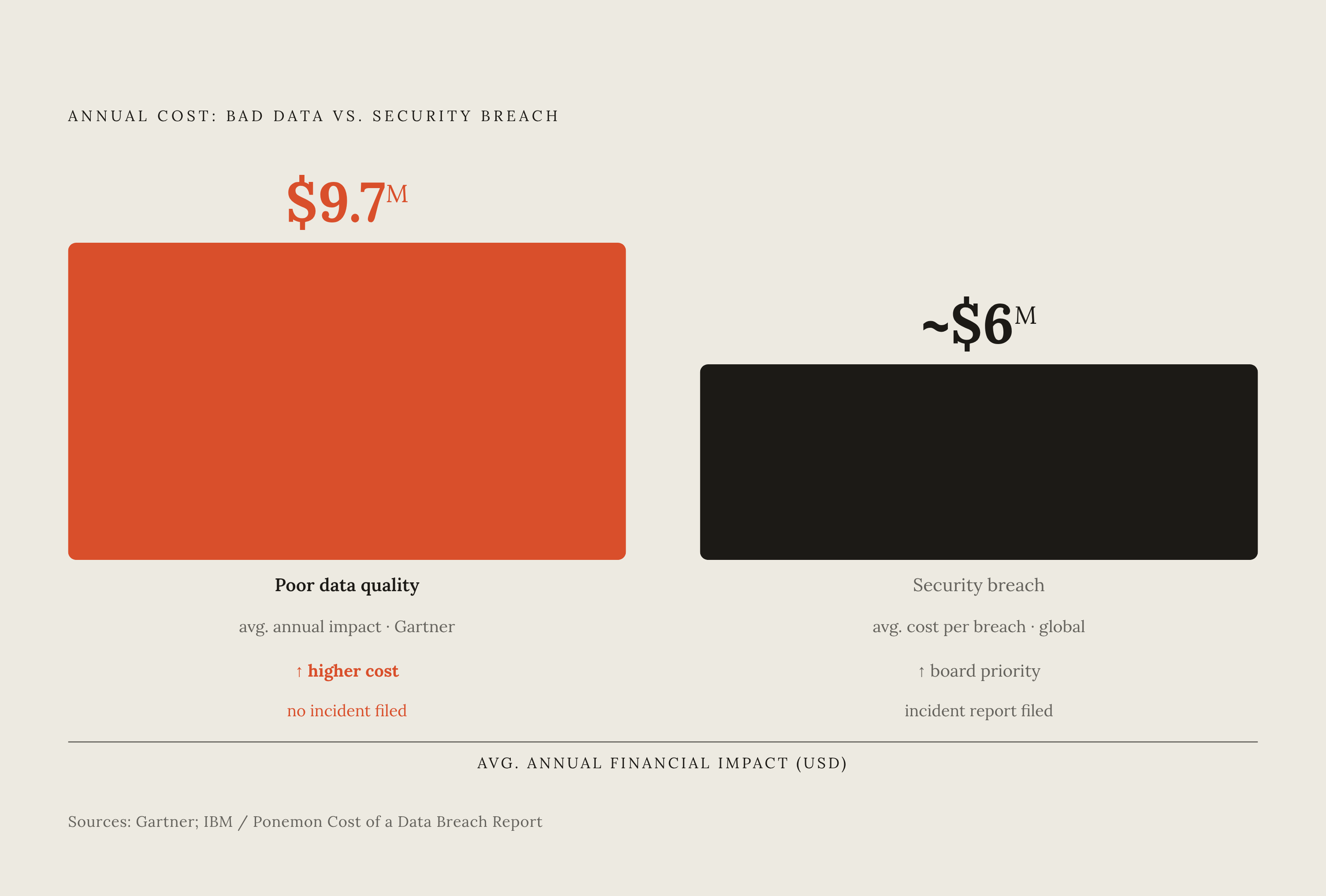
Setting the two numbers side by side reveals a stark imbalance. Gartner research puts the average financial impact of poor data quality at $9.7 million, well above the roughly $6 million global average cost of an actual breach. Bad data still gets a fraction of the board-level attention a breach commands, because nobody files an incident report when a table just quietly drifts wrong. That asymmetry runs backwards, and it costs organizations more than the breaches they actually staff up to prevent.
IBM's Institute for Business Value found that 43% of chief operations officers name data quality as their single most significant data priority. Over a quarter of organizations estimate they lose more than $5 million a year to poor data quality, and 7% report losses of $25 million or more. That is a standing tax on the business that never appears in an incident log anywhere.
At ground level, this cost is measured in time, not headlines. Data teams routinely spend 30 to 40% of their working hours fixing data quality problems instead of building anything new. One documented case: a $50 million company running 3,000 tables, with a team of five data engineers, logged an average of 793 hours of data downtime per month. Separately, Available data found employees spend up to 27% of their time correcting bad data, which slows every decision that depends on it downstream. A broader pattern backs this up: data teams spend 53% of engineering time on pipeline maintenance and reactive fixes rather than new work, with pipeline downtime creating close to $3 million a month in business exposure at large enterprises. The engineers writing new features are, more often than not, the same engineers patching yesterday's bad table.
AI Initiatives and the Amplified Cost of Incidents and Bad Data
AI does not fix bad data. It launders it into something that looks confident. A model trained on flawed inputs does not just fall short of its targets, it actively reinforces the errors baked into its training data, so dirty records in a cloud warehouse become corrupted model behavior at scale, repeated across every downstream decision the model touches. Anyone treating an AI rollout as a way to route around a messy warehouse has the causality backwards.
Gartner predicted that 30% of generative AI projects would be abandoned by the end of 2025, citing shaky data, unclear value, and weak governance as the drivers. Every one of those abandoned projects represents a direct financial write-off caused by a data reliability failure.
The gap between ambition and readiness runs wide. IBM's Institute for Business Value 2025 CDO Study found only 26% of chief data officers feel confident their data can actually support new revenue streams driven by intelligent automation, even though 81% say their data strategy is integrated with the broader technology roadmap. A lot of organizations have built the roadmap without checking whether the data underneath it can carry the weight, and that mismatch is where AI investment quietly evaporates.
The threat runs the other direction too. IBM's report found that one in four malicious breaches were AI-enabled, and one in five organizations reported a breach that specifically targeted an AI model or application. Only 40% had deployed access controls on their AI models and the data feeding them. The attack surface tied to AI is expanding faster than the governance built to defend it, and that gap is where the next round of breach costs is already forming.