Deduplicating and Merging CRM Records at Scale Without Breaking Parent-Child Relationships
Preserve CRM relationships by merging parents first and defining survivorship rules upfront.

CRM hygiene is the ongoing control of record identity, field accuracy, and account relationships. Deduplicating and merging CRM records at scale requires more than finding matches. The safe process defines attribute-level survivorship rules, resolves duplicate parent accounts before contacts and other children, and verifies relationship links after merging, so removing duplicates does not destroy the history they contain.
Why deduplication at scale fails as a data problem before it fails as a matching problem
Teams often treat CRM deduplication as a search problem, investing in better matching while leaving the rules for combining records unresolved. Yet identifying two records as duplicates does not establish which values should survive or where their related records should go. Matching is only the first of three jobs. Survivorship chooses the winning value for each field, and merging combines the records and reroutes their relationships.
The distinction becomes critical when a merge removes records that other objects still reference. Even when a record is clearly a duplicate, a bad merge can leave its activity history orphaned with no way to recover it. At scale, teams need to keep the meaning and relationships intact as they reduce the number of records, even as they find more duplicate pairs.
How matching logic works and where exact-key matching breaks down
Exact-key matching works when records share a stable identifier, but typos, nicknames, and inconsistent formatting leave genuine duplicates outside its reach. For contacts, verified email is the strongest single key once it has been lowercased and stripped of formatting artifacts. For accounts, canonical company domain is more stable than display name. Comparing “Acme Inc” with “Acme, Inc.” exposes the weakness of treating display text as identity. Normalization removes that avoidable noise before more flexible comparisons begin.
Normalization must also precede fuzzy matching so that comparisons focus on identity. Phone numbers should be reduced to digits for comparison, while entity suffixes such as “Inc,” “LLC,” and “Corp” should be removed from comparison values and preserved in stored names. Algorithm choice then depends on the field. Jaro-Winkler suits personal names because it rewards prefix agreement, while Levenshtein catches single-character errors in short strings such as postal codes or account numbers. Soundex and Metaphone address spelling variants that sound alike.
These signals support confidence-based decisions: high-confidence matches can qualify for automatic merging, mid-range matches require human review, and low-confidence records stay separate. A name alone is not sufficient evidence. Composite keys such as name plus phone plus zip help when no individual field establishes identity. To calibrate those thresholds, use labeled examples from real CRM records, including duplicates the team actually complained about.
If one CRM uses email as its primary key and another uses phone, the same entity can come in under different IDs. A merge on one side may then orphan the corresponding record or prompt the sync to recreate the removed duplicate. Local matching accuracy is not enough in that environment. Both systems have to use the same identity rules.
Survivorship rules: deciding which value wins at the attribute level, not the record level
A stale import can contain a blank phone field while the other duplicate holds a verified number. If the imported record wins wholesale, the merge replaces useful information with nothing. The match may still have been entirely correct. The failure lies in treating a record as uniformly better than its counterpart when its individual fields have different strengths. Attribute-level survivorship keeps that information from being lost by using a set rule to choose the value for each field.
The most-complete rule addresses the blank-field failure directly, allowing a populated value to beat an empty one. Source priority instead favors a more authoritative source, such as a verified enrichment feed over manual entry. Most-recent selects the last-updated value for fields such as title or phone that change with job moves. These rules answer different questions about a value. Completeness establishes whether information exists, while authority and recency help determine which populated value deserves to survive.
Quality-score rules use completeness or validation scores to compare values, while conditional rules change the choice based on the state of the field. A conditional rule might retain a verified CRM value regardless of recency. Hybrid chains combine these approaches in sequence. Source priority can govern first, with most-recent breaking a tie, rather than forcing one rule to resolve every conflict. Define these field-level decisions before any merge, because record-by-record judgments under time pressure produce inconsistent outcomes that are difficult to audit.
Why merge order is the highest-stakes decision in a bulk deduplication project
Orphaned history and invisible relationship value are more damaging than an untidy account list. Salmon Labs’ case study describes a company with hundreds of thousands of account records where one client appeared as six disconnected records, including “Cushman & Wakefield (HQ),” “C&W - Brisbane,” and “Cushman Wakefield Commercial Ireland Ltd.” Without parent-child linkage, the company could not see the total value of the relationship. Pipeline reviews became arguments about which account represented the client.
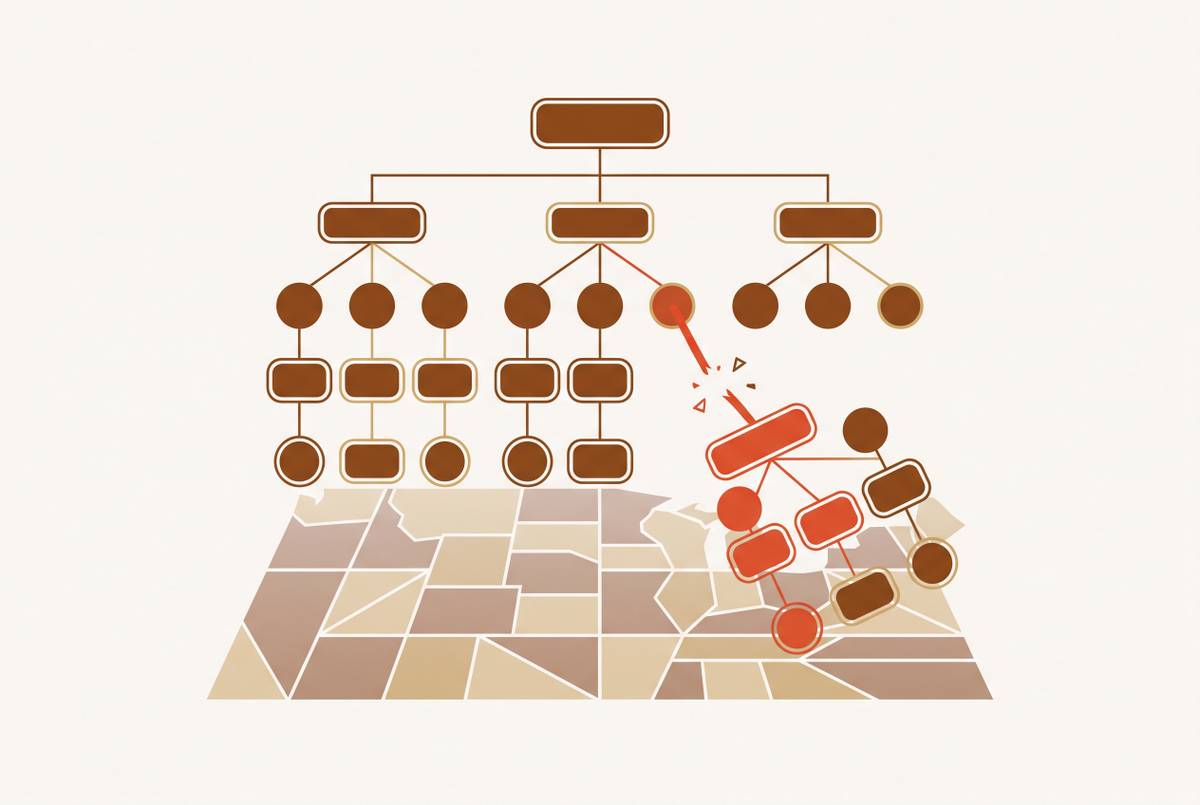
Survivorship protects individual values, but merge order protects the relationships around them. Teams must resolve duplicate parent accounts before duplicate contacts because the correct parent must be in place before they can choose the surviving contact. Deleting a duplicate contact prematurely can detach its activity history with no recovery path. Child records, including opportunities, tickets, and activities, must then be reparented to the surviving master account. Lookup relationships from other objects require verification after the merge rather than an assumption that every link transferred correctly.
Because these decisions can be irreversible, production safeguards belong before execution. Back up the CRM, run the process in a sandbox, and merge a small sample batch first. That sequence exposes bad rules before they reach the real pipeline. It also separates preparation from the pressure to process a large candidate pool.
The execution framework then has three phases. Phase 1 defines master criteria and field-level survivorship before any data is touched. Phase 2 clears deterministic exact matches in batches, working through parents first, confirming hierarchies, and only then moving to contacts. Phase 3 sends fuzzy matches and edge cases to human review, reserving automatic merging for the highest-confidence matches. Confidence governs automation within the parent-first sequence.
How native CRM platforms constrain bulk merging and what that means for planning
Salesforce caps native merges at three records per operation. Its Duplicate Jobs can scan large record volumes but are available only in Performance and Unlimited editions. Native merging also needs a person to act each time. These are separate planning constraints. How much a tool can scan does not tell a team how fast it can merge the matches it finds in the required order.
HubSpot’s default duplicate review presents records pairwise, while Data Hub Professional and Enterprise support bulk merging of up to 50 records at a time. Its scale deduplication tools are gated behind Data Hub, also identified as Operations Hub, Professional and Enterprise tiers. Zoho auto-merges exact matches by module when selected deduplication fields contain identical values and no conflicts are detected. The tool must be launched manually for each module. Zoho has no native fuzzy matching, so near-matches require supplemental tooling or manual review.
These limits affect how teams build batches and how much they can review. A team that plans around them can work out how to find candidates, run merges, and handle exceptions as separate tasks before the project starts. For synchronized CRMs, that plan must also name a shared survivor and set down the order in which both systems will run the merges while the sync stays active. Otherwise, a successful merge in one CRM can be undone by the other.
Where supplemental tooling and AI agents extend what native platforms can do
At scale, teams cannot keep up with ongoing checks if they have to review every candidate by hand. Supplemental tooling extends the fields, comparisons, and duplicate groups that a team can process under its rules. Insycle’s bulk merge tooling can combine standard or custom fields using exact or fuzzy comparisons. It addresses one-character drift, nickname pairs, entity-suffix variations, formatted phone numbers, and multi-field combinations. Working on whole duplicate groups rather than only pairs broadens the matching layer without changing the need for explicit survivorship and sequencing.
AI-driven approaches extend that layer through weighted, multi-field matching, clustering on composite signals, and external validation of attributes such as addresses, phone numbers, and email deliverability. They can also evaluate completeness, consistency, and business relevance when recommending a master record. The recommendation states its confidence and explains the reasoning in plain language. A person still has to review matches below the automatic-merge threshold, so even with more automation, a weak signal needs human approval before a merge.
Salmon Labs’ resolution of 514K records illustrates the research component of this approach. Its AI agents checked company registries, SEC filings, LinkedIn, and news against each other to find out what each entity was. “C&W - Brisbane” and “Cushman & Wakefield (HQ)” resolved to the same organization through research. The agents then mapped HQ, subsidiaries, regional offices, and divisions into a single account tree in three weeks. Manual work had stalled after months on a fraction of the total records.
The operational distinction is between flagging a problem and applying a governed fix. An alerting system still waits for someone to act, whereas an agent can detect, propose, and apply a correction autonomously within the defined rules. This affects whether checks and fixes keep running or have to wait until someone has time to review them. Automation enforces discipline at scale once that discipline has been defined.
Mapping parent-child hierarchies as a distinct step, not an output of deduplication
Parent-first merging presupposes that the system knows which accounts are parents. Removing records with similar names cannot, on its own, tell a CRM which accounts are parents. Corporate hierarchies include HQ, subsidiaries, regional offices, and divisions, whose names may diverge across acquisitions and migrations. The existing fields may be least reliable where the structure is most complex. Hierarchy mapping must therefore be built and validated before merge execution.
Entity resolution supplies the research that precedes that mapping. Traditional deduplication compares fields already in the CRM, while entity resolution uses sources outside it to find out which organization a record represents without relying on the CRM’s description. This separates identity from position in a hierarchy. Resolving two names to the same organization does not, by itself, decide whether their records represent duplicate accounts or distinct parts of its structure. Once the structure is mapped, accounts can be resolved top-down, with parent survivorship confirmed before any child merge.
That structure also changes after the cleanup. Companies restructure, are acquired, and open or close regional offices, so a previously correct hierarchy can drift. A regular refresh keeps the merge sequence in line with the relationships as they are now, even when the old map is out of date. The Salmon Labs engagement used a quarterly refresh for this reason. Hierarchy maintenance belongs to both initial project preparation and ongoing CRM hygiene.
How do you keep your CRM data clean and accurate over time?
A cleaned CRM begins accumulating duplicates again because its entry points remain active. Forms, imports, integrations, partner feeds, and outbound prospecting workflows continually introduce records. Entry is the strongest place to intervene. Enforcing verified email and canonical company domain at record creation prevents the majority of duplicates from reaching the database. Exact-match gates block obvious duplicates, while fuzzy checks show likely matches for a rep to review before adding another record.
Event-driven deduplication extends that control to the moment a record is created or updated, ahead of weekly or monthly scripts. Its purpose is to prevent the candidate pool from growing into another bulk project. A JOIN condition can change behavior after a schema migration, or a deduplication step can stop removing duplicates after a backfill, without the pipeline failing. Continuous monitoring must examine the data itself.
Volume anomalies provide one concrete warning signal. Sudden record-count spikes can indicate a JOIN that became a Cartesian product or a deduplication step that failed silently. Detecting those changes early prevents bad batches from spreading into routing, attribution, and forecasting. AI-dependent workflows make this control especially consequential because an agent acting on a duplicate repeats the error at machine speed. CRM hygiene is infrastructure for those downstream decisions, and data reliability is a prerequisite for AI deployment.