What a Clean CRM Actually Looks Like for a B2B Sales Team
Six data dimensions separate a usable CRM record from an unreliable one.
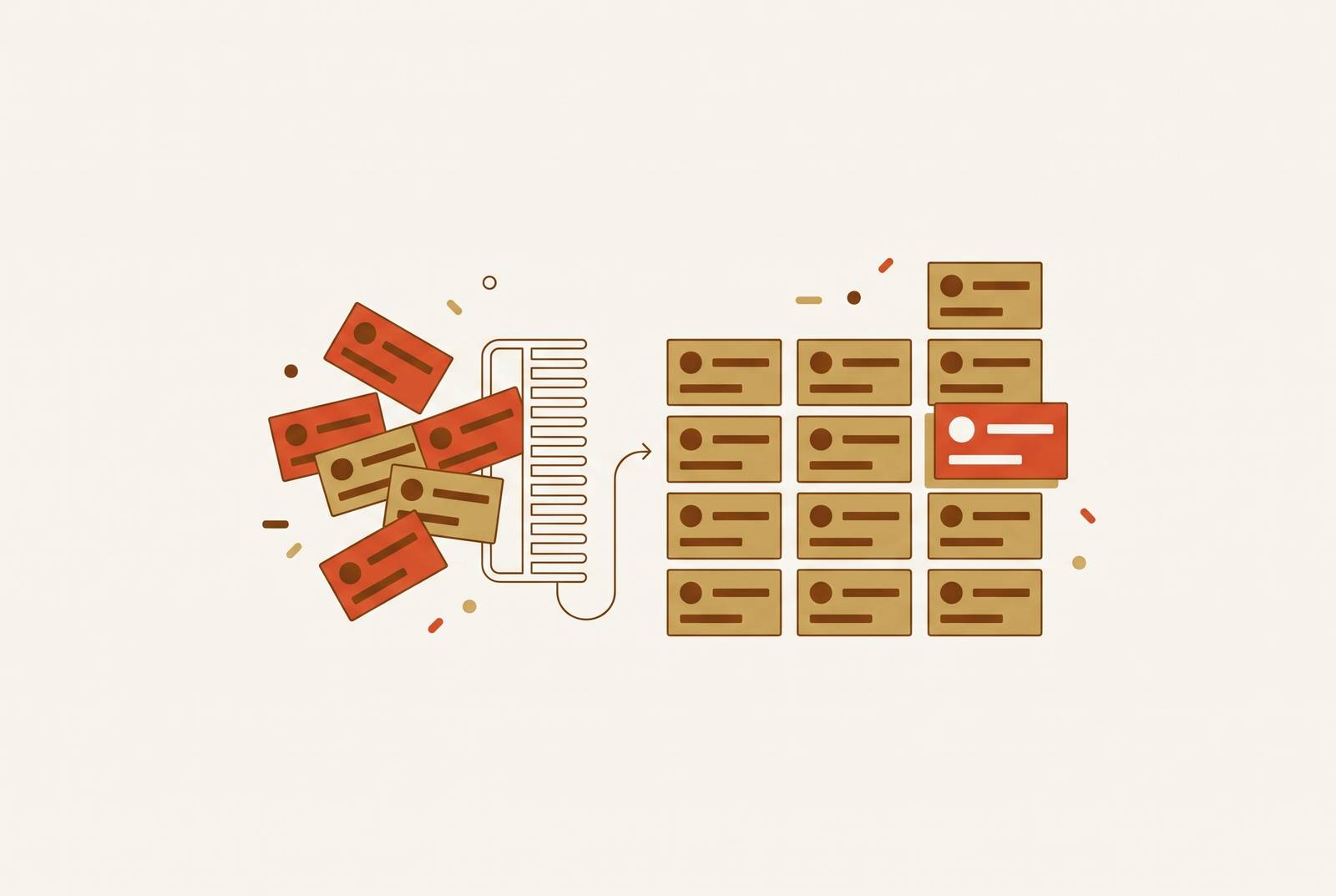
CRM hygiene is the ongoing work of keeping customer records accurate, complete, consistent, timely, unique, and valid. For a B2B sales team, a clean CRM contains usable records that support outreach, routing, and forecasting. That state depends on defined ownership, automated checks, and continuous maintenance.
Why the CRM as "source of truth" breaks down in practice
The CRM is supposed to be the system of record, yet its contents depend on people whose primary task is selling. When reps are under pressure to meet quota, they skip fields, enter placeholder text, or use different words for the same role. The database accepts what they enter. Pintel's 2026 guide identifies the structural entry points, including manual entry, unvalidated list imports, unenforced required fields, multiple entry points without governance, and no scheduled audits. These conditions make unreliable data predictable.
Salesmotion's 2026 decay analysis describes this as a systems problem. When data entry competes with quota-carrying activity, it loses. Even when people enter information with care, it can go out of date once it is in the database. Contacts change jobs, companies rebrand, and phone numbers stop working while the old records are still there to use. A record's presence in the CRM therefore says little about whether it still describes the person or company a rep intends to reach.
The six failure modes that visibly degrade a B2B sales team's execution
Duplicate records spread the details of one relationship across more than one entry. The same contact or company can receive double outreach because different reps see different versions of it. Without a job title, company size, or industry, a rep lacks the information needed to judge fit, even when the person's identity is correct.
Outdated information directs effort toward a situation that no longer exists. A contact may have left the company while the record still presents them as part of its buying committee. Inconsistent formatting breaks a different part of execution. “VP of Sales,” “Vice President, Sales,” and “VP Sales” describe the same role, but treating them as different values fragments filters and segments.
Inaccurate data at entry was never correct in the first place. Human error, bad imports, and fake form submissions can produce records that misdirect outreach from their creation. Unassigned or orphaned records have no owner, activity, or next step. They still appear in coverage reports, but no one is in charge of moving them forward. These distinctions separate a record that needs updating from one that needs completion, correction, normalization, consolidation, or ownership.
What bad CRM data actually costs the revenue team
The first cost appears in the rep's working day. Wrong numbers, unreachable contacts, and missing information turn selling time into verification work. That work adds up across the team, and what reps do as a result can look like weak sales execution. Pintel describes the distinction plainly as a data problem that can be mistaken for a performance problem.
Tomba's 2026 sales management guide identifies the next consequence as lost trust. Reps keep their real pipeline in personal spreadsheets, email performance deteriorates, and forecasts miss because active deals are attached to unreachable contacts. Managers then make decisions from a system their teams no longer treat as authoritative. Territory planning compounds the problem when unreliable account data misallocates resources before outreach begins.
Deal slippage is another cost of pursuing stale contacts or missing buying signals. Salesmotion cites sixteen lost deals per quarter as a directional consequence of decay compounding across a sales team. As more email bounces, domain reputation suffers, so even good emails sent to valid addresses can land in spam.
The six dimensions that define whether a CRM record is actually usable
ZoomInfo's 2026 B2B data quality guide defines six dimensions that must hold together, namely accuracy, completeness, consistency, timeliness, uniqueness, and validity. None substitutes for the others in practice. A complete record can be outdated, while an accurate record can still omit the fields needed to route it.
Accuracy means the email and phone belong to the person named on the record. Completeness means the fields required for action are populated with real information. Consistency means values that mean the same thing use the same format across records, so filters and reports find the people or companies they should. Timeliness means the role and company reflect the contact's current situation.
Uniqueness means each person has one record, with no other versions that split their activity history or who is in charge of outreach. Validity concerns whether the record's structure and formatting meet the rules of the workflow that must use it. That distinction is essential for automated work. A populated field can still fail validation, leaving a technically complete record unusable by routing logic or AI tools. Together, these dimensions give revenue operations teams a way to assess both factual reliability and operational readiness.
What completeness and consistency look like across contact, account, and deal records
Completeness depends on what the record must support. Tomba's guide sets a contact minimum of name, role, company, email, and phone, with those details complete and verified. In practice, usable contact data includes a verified business email, a direct phone or mobile, a current job title, and the account the person belongs to. The email must resolve before the record enters a rep's queue. A populated address alone does not meet that standard.
Account records need a different set of fields. Company size, industry, revenue band, and tech stack make an account scoreable against an ideal customer profile. Deal records instead need stage, close date, deal value, and an identified owner. When stalled opportunities have no owner or next activity, they can make the forecast look bigger than it should. A completeness measure must account for what each record type is used for, rather than give every filled-in field the same weight.
The operational requirement is picklists and dropdowns for fields that drive filters, such as job title, industry, and lead source. The goal is to have most required fields filled in, few duplicates, very few email bounces, and high enrichment coverage. Those measures give revenue operations teams a practical view of whether the configured standards produce usable records.
How do you keep CRM data clean and accurate over time?
A CRM that was clean six months ago is not necessarily clean today. Salesmotion identifies job changes as its largest single driver because one move can invalidate email, phone, title, and account mapping together. The same event can also create an opportunity. A champion at a new company can provide a warm introduction, but only when the team learns about the move and stops pursuing the old address.
An acquisition can leave records attached to a defunct entity, with account hierarchies and firmographic fields needing updates that most CRMs do not trigger automatically. Contact verification alone cannot address that change. Keeping data up to date takes rolling re-verification, enrichment of missing fields from verified external sources, and automated checks for job moves.
Coverage also depends on the sources available for enrichment. Salesmotion says no single B2B database has data on every company, contact, geography, and attribute. Waterfall enrichment addresses that limitation by querying sources in sequence until a match is found. ZoomInfo's guide states that entry validation and rolling re-verification cost less than repairing decay after it has spread through scoring and routing.
Eliminating duplicates and enforcing uniqueness across contact, lead, and account objects
A person can exist as a lead, a contact, and an account contact in parallel because most CRMs treat those as separate objects without automatic deduplication across them. A clean-looking contact table can still coexist with competing versions elsewhere in the system.
Duplicate entries inflate pipeline counts and can cause enrichment costs to be paid repeatedly for the same underlying record. Pintel also identifies a direct CRM cost where license tiers depend on contact counts. Removing visible duplicates from one object does not resolve the broader problem.
Match rules at creation check existing email, domain, or name combinations before a new record is written. Continuous merge policies then use defined matching fields and merge rules to consolidate duplicates systematically. Manual deduplication sprints are partial and temporary because they do not prevent the next import or entry from recreating the problem. Cross-object enforcement makes uniqueness a standing condition.
Why AI tools in the GTM stack make CRM data quality a harder requirement than it was before
AI-powered GTM tools act on CRM data and leave its underlying flaws in place. Scoring, personalization, sequencing, and forecasting all depend on the inputs they receive. Automation accelerates the consequences of flawed records. ZoomInfo describes stale and incomplete inputs as a source of misdirected outreach, inaccurate scores, and forecasts that miss before people can intervene. Confident-sounding output can also make the underlying error less obvious.
SuperOffice's 2026 CRM research cites Gartner's finding that the biggest barrier to AI-powered CRM is customer data quality, consistency, and accessibility. Missing fields, inconsistent formats, and duplicates can thus hold up deployment and need more than minor housekeeping. Adding an AI tool makes failures in the six-dimension standard harder to contain once workflows act on them.
The diagnosis can go wrong as well. Teams may revise messaging, subject lines, or sequences while failing to examine the bounce report. ZoomInfo identifies this pattern as a misdiagnosis in which stale contacts and non-normalized data remain the cause while messaging becomes the target of repair. Autonomous execution makes that misplaced effort more expensive. The operational implication is to establish accurate, complete, consistent, timely, unique, and valid inputs before activating AI workflows, rather than waiting for poor outputs to expose the gaps.
The governance structure that keeps a CRM clean without depending on rep discipline
Sales ops should own contact and account field standards, marketing ops should own lead-source integrity and form mappings, and customer ops should own post-sale contact quality where renewals depend on accurate stakeholders. Tooling cannot substitute for that allocation of responsibility. Without it, no one is accountable for deciding what a usable record contains or correcting standards when workflows expose a gap.
Those owners need enforcement at the point of entry. Required fields, picklists, and validation rules prevent defects from spreading into scoring, routing, and reporting. Pintel's Enrich → Score → Decide → Activate framework separates record acquisition from operational use. Records that fail quality or fit criteria are kept in staging for future opportunities, so unusable data stays out of active workflows. Continuous policies then merge duplicates, standardize values, and enrich accounts without relying on manual audits alone.
Monitoring closes the loop between rules and results. Completeness rate, duplicate rate, bounce rate, and enrichment coverage need a defined review cadence and a named person accountable for each measure. Salesmotion recommends hygiene reviews at least quarterly, with ongoing checks for entry errors and decay between reviews. Feedback from reps, bounce reports, and AI outputs should help teams update enrichment rules and scoring criteria as conditions change.
A clean CRM is therefore an operating system of ownership, enforcement, and monitoring. Its practical value is trust. Reps can act on the records they receive, and leaders can use the resulting pipeline information without first reconstructing reality outside the CRM.